


Fixed Fee Consulting: Guide for IT Professionals in Canada and USA

Updated: Aug 16, 2025

Fixed fee consulting is catching the attention of IT professionals across Canada and the USA. You might expect most consultants to stick with the old hourly grind, but value-based pricing models have actually increased consultant profitability by up to 30 percent compared to traditional hourly billing. The real surprise is that fixed fee consulting does more than just boost income and predictability. It can flip everyday client relationships into strategic partnerships and make your consulting business far more resilient than you think.
Table of Contents
Quick Summary
Takeaway | Explanation |
Define Project Deliverables Clearly | Clear deliverables help clients know what to expect and facilitate effective pricing strategies. |
Establish Realistic Timelines | Setting achievable timelines is crucial for managing client expectations and delivering quality results. |
Calculate Costs Carefully | Understanding your expenses ensures competitive pricing while maintaining profitability in fixed fee consulting. |
Focus on Client Relationship Building | The fixed fee model encourages trust and long-term partnerships by providing financial predictability. |
Consider Project Complexity for Pricing | Use fixed fees when project parameters are well-defined to maximize efficiency and profitability. |
What Is Fixed Fee Consulting?
Fixed fee consulting represents a strategic pricing model that transforms traditional consulting engagements by establishing a predetermined, transparent cost for specific services. Unlike hourly billing arrangements, this approach provides clients with clear financial expectations and consultants with a predictable revenue stream.
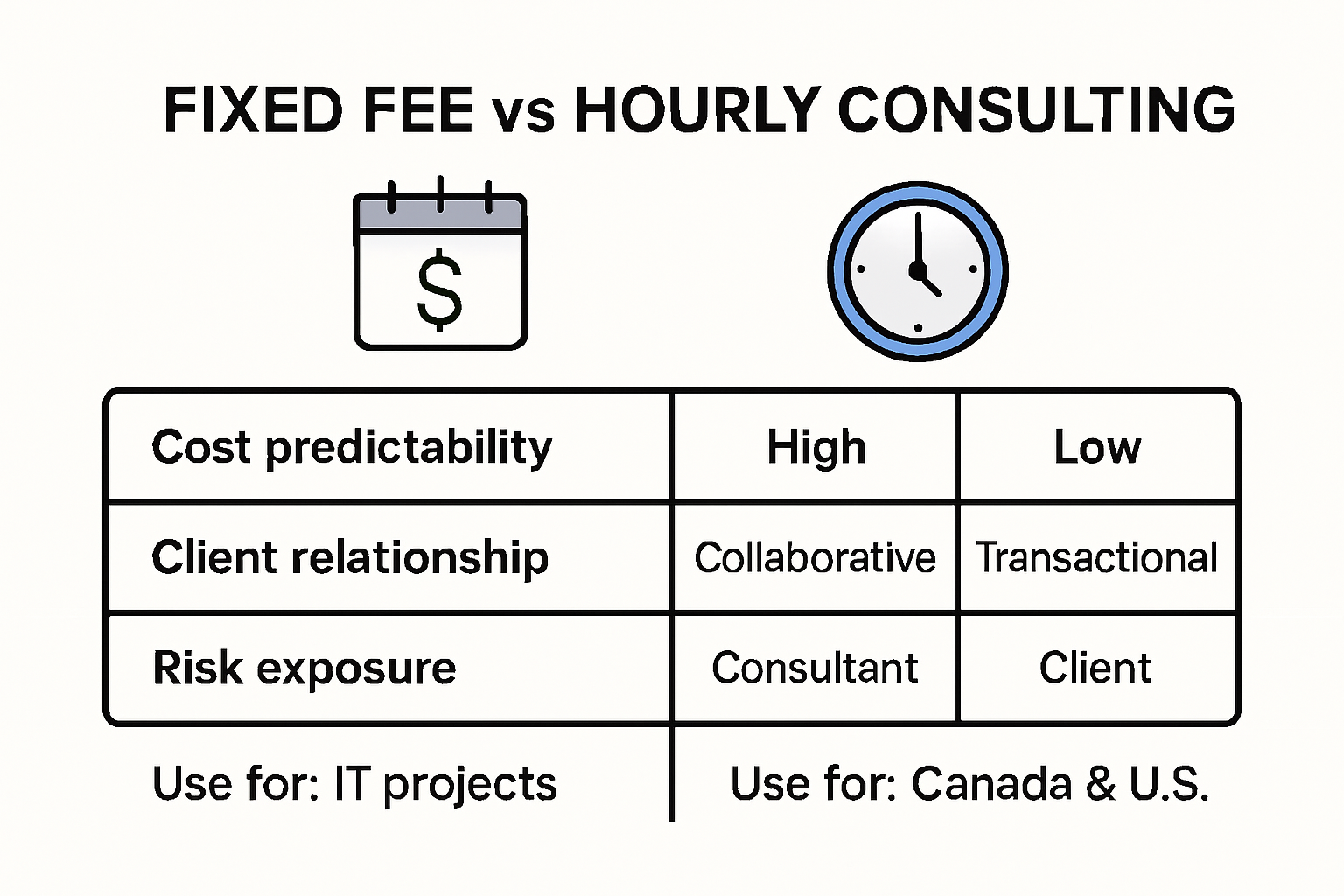
To help IT professionals quickly compare the features and considerations of Fixed Fee versus Hourly Consulting, the table below summarizes the key differences highlighted in the article.
Feature / Consideration | Fixed Fee Consulting | Hourly Consulting |
Pricing Transparency | High – upfront, predictable costs | Variable – dependent on hours logged |
Income Predictability | Stable, easier to forecast | Fluctuates based on billable hours |
Client Relationship Impact | Fosters trust and partnership | Transactional, less strategic focus |
Incentive for Efficiency | Strong – rewards fast, effective work | Limited – paid for time spent |
Suitability | Best for well-defined projects | Preferred for open-ended/uncertain |
Billing Process | Simplified, less administrative work | Requires detailed time tracking |
Risk Exposure | Consultant manages project risk | Client absorbs more risk |
The Core Principles of Fixed Fee Consulting
Fixed fee consulting fundamentally shifts the traditional consulting paradigm from time-based billing to value-based pricing. In this model, consultants charge a set price for a defined scope of work, rather than billing by the hour. This approach offers significant advantages for both IT professionals and their clients.
The key differentiator is the focus on deliverables and outcomes rather than time spent. According to Harvard Business Review, value-based pricing models can increase profitability by up to 30% compared to traditional hourly billing. For IT professionals, this means creating clear, measurable project parameters that align directly with client objectives.
Benefits and Considerations
Fixed fee consulting provides multiple strategic advantages for IT professionals. Clients appreciate the predictability of costs, which eliminates the uncertainty associated with open-ended hourly billing. Consultants benefit from simplified billing processes and the ability to potentially earn more by working more efficiently.
Research from Consulting.com reveals that fixed fee models can increase client trust and satisfaction. Clients know exactly what they will pay upfront, which reduces financial anxiety and creates a more transparent professional relationship. For IT professionals, this model incentivizes efficiency and expertise, rewarding consultants who can deliver high-quality results quickly.
The implementation of fixed fee consulting requires careful scoping and clear communication. Successful consultants must:
Precisely define project deliverables
Establish realistic timelines
Create comprehensive project proposals
Build in appropriate contingency margins
By mastering these elements, IT professionals can develop a robust fixed fee consulting approach that benefits both themselves and their clients. The key is balancing fair compensation with client value, transforming consulting from a time-based service to a results-driven partnership.
Benefits for IT Professionals in North America
Fixed fee consulting offers numerous strategic advantages for IT professionals across North America, transforming traditional service delivery models and creating opportunities for more profitable and efficient professional practice.
Financial Predictability and Enhanced Earning Potential
One of the most significant benefits of fixed fee consulting is financial predictability. By establishing clear project scopes and predetermined rates, IT professionals can create more stable income streams. Research from McKinsey indicates that value-based pricing models can increase consultant profitability by up to 25% compared to traditional hourly billing.
The fixed fee model incentivizes efficiency and expertise. Consultants who can deliver high-quality results quickly will effectively increase their hourly rate, creating a direct correlation between skill and compensation. This approach rewards professionals who develop streamlined processes and deep technical knowledge.

Strategic Advantages in Client Relationships
Fixed fee consulting fundamentally transforms client interactions. According to Consulting.com, clients appreciate transparent pricing models that eliminate billing uncertainties. This approach builds trust and positions IT professionals as strategic partners rather than hourly service providers.
The model encourages more collaborative relationships. Clients understand exactly what they will receive, and consultants are motivated to deliver exceptional value. This alignment creates stronger, more long-term professional partnerships. IT professionals can explore advanced consulting strategies that go beyond traditional service delivery.
Professional Flexibility and Business Growth
Fixed fee consulting provides IT professionals with unprecedented flexibility in managing their professional practice. Gartner research suggests that professionals using fixed fee models can more effectively control their workload, select projects aligned with their expertise, and maintain better work-life balance.
The model also supports business scalability. By developing standardized service packages, IT professionals can create repeatable, efficient consulting products. This approach allows for easier marketing, faster client acquisition, and more predictable business growth. Consultants can focus on building specialized expertise rather than tracking billable hours.
Successful implementation requires careful project scoping and clear communication. IT professionals must:
Develop comprehensive project proposals
Define precise deliverables
Establish realistic timelines
Create appropriate contingency margins
By mastering these elements, IT professionals can transform fixed fee consulting from a pricing strategy into a comprehensive business approach that maximizes professional potential and client satisfaction.
How to Set a Fixed Fee Rate
Establishing an effective fixed fee rate requires strategic planning, comprehensive cost analysis, and a deep understanding of market dynamics. IT professionals must develop a nuanced approach that balances fair compensation with competitive pricing.
Cost Calculation and Value Assessment
The foundation of setting a fixed fee rate begins with a thorough cost calculation. According to AIGA’s professional guidelines, consultants must first determine their baseline hourly rate by considering direct costs, overhead, and desired profit margin. This involves calculating total business expenses, including technology investments, professional development, software subscriptions, and personal living expenses.
Stanford University’s IT service management research recommends a comprehensive approach to rate setting that goes beyond simple cost recovery. IT professionals should consider:
Direct labor costs
Indirect operational expenses
Technology and software investments
Professional liability insurance
Ongoing skill development
Profit margin objectives
Market Positioning and Competitive Analysis
Successful fixed fee rate setting requires understanding the broader market context. IT professionals must conduct thorough competitive research to position their services effectively. Gartner’s consulting pricing studies highlight the importance of differentiating services based on specialized expertise and unique value propositions.
The key is not to compete solely on price but to demonstrate superior value. Consultants should:
Research local and regional market rates
Analyze competitors' pricing structures
Identify unique skill sets and specializations
Develop service packages that highlight distinctive capabilities
Risk Management and Pricing Flexibility
Fixed fee consulting requires careful risk management. Research from McKinsey suggests building flexibility into pricing models to account for potential project complexities.
Professionals can explore advanced pricing strategies by:
Creating tiered service packages
Developing clear scope definition mechanisms
Establishing contingency margins
Implementing transparent change management processes
The most successful IT consultants view fixed fee rates as dynamic tools for value creation. By combining meticulous cost analysis, market understanding, and strategic flexibility, professionals can develop pricing models that attract clients, ensure profitability, and reflect the true value of their expertise.
The following table outlines the essential steps IT professionals should follow when setting a fixed fee rate, based entirely on procedures detailed in the article.
Step Number | Action | Description |
1 | Calculate Direct and Indirect Costs | Tally all business expenses, technology, and overhead. |
2 | Determine Desired Profit Margin | Decide on target profitability beyond covering costs. |
3 | Conduct Market Research | Analyse competitors’ rates and identify unique offerings. |
4 | Assess Value and Service Differentiators | Highlight specialized skills and value to clients. |
5 | Define Scope and Deliverables | Outline clear project objectives, milestones, and outputs. |
6 | Build in Contingency Margins | Add allowances for unforeseen project complexities. |
7 | Establish Flexible Pricing Mechanisms | Consider tiered packages and change management processes. |
When to Choose Fixed Fee Over Hourly Pricing
Selecting the appropriate pricing model is crucial for IT professionals seeking to optimize their consulting practice. Understanding when to leverage fixed fee pricing over traditional hourly rates can significantly impact business success and client relationships.
Project Complexity and Scope Definition
Fixed fee pricing becomes most advantageous when project parameters are clearly defined and predictable. According to Catalyst:Ed, these contracts work best when deliverables are specific and outcomes can be precisely articulated. IT professionals should consider fixed fee models for projects with:
Well-documented technical requirements
Clearly defined project milestones
Predictable implementation timelines
Minimal anticipated scope changes
George Mason University’s research highlights that fixed-cost agreements provide significant benefits when project scopes are transparent, enabling competitive bidding and enhanced cost control. This approach rewards consultants who can efficiently deliver high-quality results within predetermined parameters.
Client Relationship and Trust Dynamics
Fixed fee pricing can substantially improve client trust and transparency. By establishing clear expectations upfront, IT professionals demonstrate professionalism and commitment to delivering value. McKinsey consulting research indicates that clients appreciate pricing models that eliminate billing uncertainties and provide financial predictability.
The fixed fee approach positions consultants as strategic partners rather than hourly service providers. Clients benefit from:
Predictable budgeting
Reduced financial risk
Clear performance expectations
Simplified procurement processes
Professionals can explore strategic consulting approaches that leverage these relationship-building opportunities.
Risk Management and Operational Efficiency
Fixed fee models offer unique advantages in risk management and operational efficiency. The Federal Acquisition Regulation emphasizes that firm-fixed-price contracts provide pricing stability that protects both consultants and clients from unexpected cost fluctuations.
Successful implementation requires careful evaluation of project characteristics. Consultants should avoid fixed fee pricing for:
Projects with highly uncertain requirements
Engagements involving significant potential scope creep
Emerging technology implementations with undefined parameters
Consulting work requiring extensive research or exploratory phases
Mastering the nuanced decision between fixed fee and hourly pricing represents a critical skill for IT professionals. By understanding project dynamics, client needs, and potential risks, consultants can strategically select pricing models that maximize value, efficiency, and professional reputation.
Frequently Asked Questions
What is fixed fee consulting?
Fixed fee consulting is a pricing model where consultants charge a predetermined, transparent cost for specific services, rather than billing by the hour. This model provides clients with clear financial expectations and consultants with predictable revenue streams.
What are the benefits of fixed fee consulting for IT professionals?
The benefits include financial predictability, enhanced earning potential, improved client relationships, professional flexibility, and the ability to scale business operations through standardized service packages.
When should IT professionals choose fixed fee pricing over hourly pricing?
Fixed fee pricing is most advantageous for projects with clearly defined parameters and deliverables, predictable timelines, and minimal anticipated scope changes. It fosters trust and transparency in client relationships.
How can IT professionals effectively set a fixed fee rate?
To set a fixed fee rate, IT professionals should conduct a thorough cost analysis, assess market positioning, and consider risk management. This includes calculating direct and indirect costs, researching competitive rates, and defining project deliverables clearly.
Take Control of Your Consulting Career with Expert Guidance
Struggling to price your IT services or feeling uncertain about switching to fixed fee consulting? Many independent consultants in Canada and the USA wrestle with unpredictable income, complex client relationships, and the fear of scope creep. If you want to move from hourly billing to a more strategic, value-based pricing model, you need practical resources and a proven roadmap.

Unlock practical tools, expert mentorship, and real-world frameworks that have helped so many consultants thrive in this exact transition. Learn from the bestselling guide Becoming a Solo Consultant – The Consultant’s Compass and its companion bonuses. Visit The Consultant’s Compass right now to get clear on pricing, project scoping, and building a consulting business with confidence. Do not wait to take the next step and create a future with stability, growth, and freedom.
Recommended
Comments