


Consulting Payment Terms for IT Professionals: Canada & USA 2025

Consulting payment terms shape every project an IT professional takes in Canada and the USA. Most people assume the biggest challenge is figuring out the right billing rate. Not quite. The real power lies in understanding how to get paid reliably, how to prevent disputes, and which model to choose. Here is something that might surprise you. Typical IT consultant rates in 2025 range from $100 to $250 per hour, and fixed price contracts are being structured to include payments between 10 and 20 percent of the project’s value for specific deliverables. Even so, a well-written contract does more than just lock in your pay; it sets the tone for smooth client relationships, safeguards your intellectual property, and reduces risk. If you want to stay ahead in this ever-changing field, what really matters is how you structure these agreements from the start.
Table of Contents
Quick Summary
Understanding Consulting Payment Terms in IT
Consulting payment terms represent the financial framework that governs how IT professionals charge for their services and receive compensation. These structured agreements are critical for establishing clear expectations, protecting both consultant and client interests, and ensuring predictable revenue streams in the dynamic world of technology consulting.
Payment Structures in IT Consulting
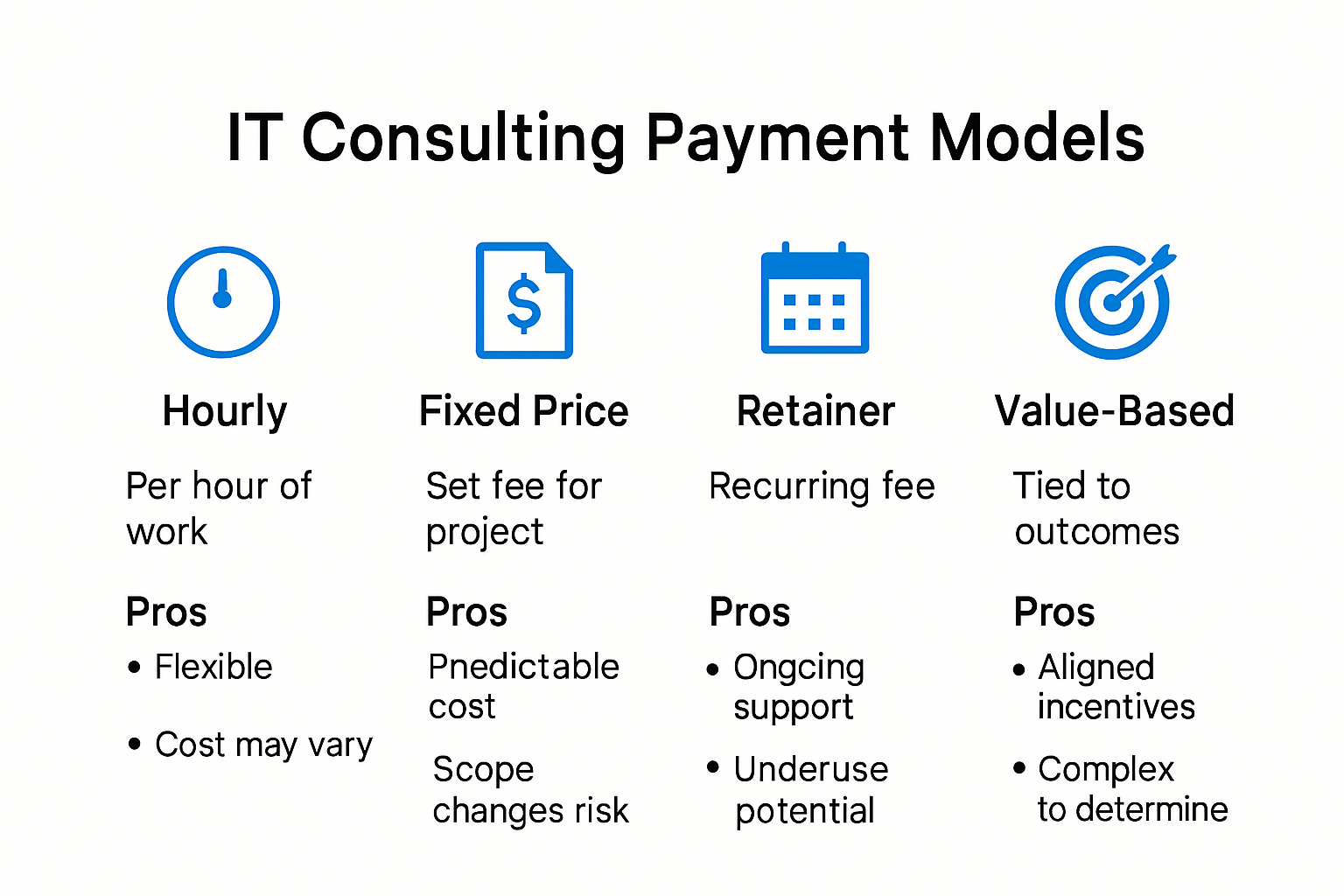
In the IT consulting landscape of 2025, professionals have multiple payment models at their disposal. Learn more about solo consulting strategies that can help you choose the most appropriate payment structure for your services.
Hourly BillingHourly billing remains the most traditional and prevalent payment method for IT consultants. According to research on consulting rates, IT consulting rates in North America typically range from $100 to $250 per hour in 2025. This model provides flexibility for projects with undefined scopes or complex technical requirements that may evolve during implementation. Consultants track their time meticulously, documenting work performed and submitting detailed invoices that break down hours spent on specific tasks.
Fixed Price ContractsFixed price contracts offer an alternative approach where consultants agree to complete a specific project for a predetermined total cost. This model benefits clients by providing budget certainty and helps consultants by establishing clear project boundaries. Successful fixed price contracts require extraordinarily precise project scope definition and robust change management protocols to prevent scope creep and potential financial losses.
Payment Term Considerations
Effective consulting payment terms extend beyond simple rate determination. Official data from Statistics Canada highlights the importance of understanding broader economic trends that impact consulting service pricing.

Key considerations for establishing robust payment terms include:
- Payment Frequency
: Determine whether you will bill weekly, bi-weekly, monthly, or upon project milestone completion
- Payment Methods
: Specify acceptable payment channels such as electronic transfers, credit card payments, or traditional bank transfers
- Late Payment Policies
: Establish clear penalties or interest charges for delayed payments
- Retainer Agreements
: Consider offering ongoing support packages with predetermined monthly rates
The most successful IT consultants recognize that transparent, well-structured payment terms are not just about financial transactions but about building trust and long-term professional relationships. By developing clear, fair, and comprehensive payment agreements, consultants can minimize potential conflicts and focus on delivering exceptional technical expertise.
Navigating the complexities of consulting payment terms requires continuous learning, adaptability, and a strategic approach to valuing professional services in an ever-evolving technological marketplace.
Popular Payment Structures for IT Consultants
In the rapidly evolving IT consulting marketplace, professionals must strategically select payment structures that balance client expectations, project complexity, and personal financial goals. Discover strategies for solo consulting success that can help you navigate these critical financial decisions.
Hourly Rate Model
The hourly rate model remains the most prevalent payment structure for IT consultants. According to global consulting rate research, IT consulting rates can range dramatically from $25 to $250 per hour, depending on specialization and regional market dynamics. In Canada and the United States, the typical hourly rate for IT consultants in 2025 falls between $100 and $175.
Hourly billing offers significant advantages for consultants working on projects with:
Undefined or evolving project scopes
Complex technical requirements
Potential for unexpected challenges or iterations
Minimal predictability in task completion time
Professionals utilizing this model must maintain meticulous time tracking, providing transparent and detailed invoices that clearly demonstrate value delivered.
Project-Based Fixed Price Contracts
Fixed price contracts represent an alternative payment structure where consultants and clients agree on a predetermined total project cost. Research from consulting rate analysis indicates that outcome-based models are gaining traction, with consultants often charging 10-20% of the total project value based on specific deliverables and achievements.
Successful fixed price contracts require:
Extremely precise project scope definition
Robust change management protocols
Clear milestone identification
Comprehensive risk assessment
This model provides clients with budget certainty while offering consultants an opportunity to demonstrate efficiency and expertise.
Retainer and Value-Based Pricing
Advanced payment structures like retainer agreements and value-based pricing are emerging as sophisticated alternatives to traditional billing methods. According to data from consulting industry analysis, these models allow consultants to align their compensation more directly with client outcomes and long-term value creation.
Retainer agreements typically involve:
Monthly fixed payments
Predetermined service levels
Ongoing technical support
Predictable revenue for consultants
Value-based pricing focuses on the tangible business impact generated by the consultant’s work, potentially offering higher compensation for demonstrable results such as increased efficiency, cost savings, or revenue generation.
Navigating these payment structures requires nuanced understanding of market dynamics, individual project requirements, and personal consulting goals. Successful IT consultants continuously adapt their approach, balancing client needs with personal financial sustainability.
Key Clauses to Include in Your Consulting Contracts
Consulting contracts serve as the foundational legal document that protects both the IT consultant and the client by establishing clear expectations, responsibilities, and boundaries. Learn more about launching your solo consulting career to understand the critical importance of robust contract development.
Scope of Work and Deliverables
A comprehensive Statement of Work (SOW) is the cornerstone of any effective consulting contract. According to consulting contract best practices, this section must meticulously detail:
Specific project objectives
Detailed deliverables
Exact timelines and milestones
Performance metrics and success criteria
Specific responsibilities of both parties
Precise definition prevents scope creep and establishes clear expectations. Consulting industry research emphasizes that ambiguity in the scope of work can lead to potential disputes and financial complications.
Confidentiality and Intellectual Property Protections

Confidentiality clauses are critical in IT consulting, where proprietary information and intellectual property represent significant value. Effective contracts must address:
Explicit definitions of confidential information
Duration of confidentiality obligations
Specific use restrictions
Consequences of information breaches
Ownership of intellectual property created during the project
Intellectual property clauses should clearly delineate ownership rights for any code, designs, or solutions developed during the consulting engagement. This protects both the consultant’s work and the client’s investment.
Risk Management and Termination Provisions
Robust contracts require comprehensive risk management clauses that address potential scenarios and protect both parties. Key provisions should include:
Liability limitations
Indemnification terms
Termination conditions
Payment terms in case of early contract termination
Dispute resolution mechanisms
The termination clause is particularly crucial, specifying the conditions under which either party can end the contract, required notice periods, and financial implications. According to professional service agreement guidelines, these provisions should be clear, fair, and comprehensive.
Crafting a well-structured consulting contract requires careful consideration of legal, financial, and professional nuances. IT consultants must approach contract development as a strategic process that balances protection, clarity, and professional relationship building. Each clause represents an opportunity to establish trust, define expectations, and create a solid foundation for successful project delivery.
Professional consultants recognize that a meticulously drafted contract is not just a legal requirement but a critical communication tool that sets the stage for productive client relationships.
Best Practices for Prompt Payment and Dispute Resolution
Prompt payment and effective dispute resolution are critical components of maintaining healthy professional relationships in IT consulting. Explore strategies for solo consulting success to understand how these practices impact your business sustainability.
Establishing Clear Payment Protocols
Effective payment protocols form the foundation of financial transparency and professional trust. Canadian payment regulation research reveals specific guidelines for payment timelines, with federal projects mandating 28 days for prime contractor payments and an additional 7 days for subcontractor compensation.
Key elements of robust payment protocols include:

Precise invoicing requirements
Explicit payment timeframes
Multiple accepted payment methods
Detailed documentation of services rendered
Clear communication channels for billing inquiries
According to contractor payment analysis, successful IT consultants implement milestone-based payment structures that align client expectations with project deliverables.
Proactive Dispute Prevention Strategies
Dispute prevention begins with comprehensive contract design and transparent communication. Contractor management research highlights several critical strategies for minimizing potential conflicts:
Develop detailed Statements of Work
Include precise performance metrics
Establish clear escalation procedures
Define specific dispute resolution mechanisms
Create transparent communication protocols
Milestone-based payment structures prove particularly effective in preventing disputes. By tying payments to specific, measurable deliverables, consultants create natural checkpoints for project validation and client satisfaction.
Implementing Effective Resolution Mechanisms
When disputes arise, having a predefined resolution framework becomes crucial. Effective mechanisms should include:
Mandatory initial negotiation periods
Clear mediation procedures
Predetermined arbitration processes
Specific timelines for resolution
Neutral third-party review options
Professional IT consultants recognize that dispute resolution is not about winning, but about maintaining professional relationships and finding mutually beneficial solutions. The goal is to create a framework that allows both parties to address concerns constructively and efficiently.
Successful dispute resolution requires a combination of clear contractual language, professional communication, and a commitment to collaborative problem-solving. By implementing these best practices, IT consultants can minimize financial risks, protect their professional reputation, and build long-term client relationships based on trust and mutual respect.
Frequently Asked Questions
What are the typical consulting rates for IT professionals in Canada and the USA in 2025?
Typical IT consultant rates in 2025 range from $100 to $250 per hour, depending on the consultant’s specialization and the complexity of the project.
What are the different payment models available for IT consultants?
IT consultants can choose from various payment models including hourly billing, project-based fixed price contracts, retainer agreements, and value-based pricing to match project needs and client’s budget.
How can I ensure prompt payment as an IT consultant?
To ensure prompt payment, establish clear payment protocols including precise invoicing requirements, explicit payment timeframes, and acceptable payment methods. Implementing milestone-based payments can also help align client expectations with deliverables.
What key clauses should I include in my consulting contract?
Important clauses in a consulting contract should include a clear scope of work and deliverables, confidentiality and intellectual property protections, and risk management provisions to safeguard both parties’ interests.
Take Control of Your Consulting Income and Project Success
Are you tired of the uncertainty around consulting payment terms, late payments, or confusing contracts? This article highlights the common struggles IT professionals face across Canada and the USA in 2025, such as unpredictable rates, scope creep, and unclear risk management. If securing reliable payments and building transparent client relationships is a priority for you, there is a way to turn uncertainty into confidence.
Let The Consultant’s Compass guide your journey from confusion to clarity. With proven frameworks, a bestselling guide, and ready-to-use bonus tools like rate calculators and contract clause guides, you can say goodbye to guesswork. Take action now—explore The Consultant’s Compass for practical resources and mentorship. Visit the landing page to access what you need to protect your business and secure your financial future. Start building client trust and set yourself up for lasting consulting success today.
Recommended Articles
- Workplace Watch: The Slow Fade of Remote Work in Canada
- Becoming a Solo Consultant
- I Wish I Had Become an Independent Consultant Sooner: Learn from My Mistake
- Why Becoming a Solo Consultant - The Consultant’s Compass Belongs on Every Canadian Consultant’s Shelf
- 5 ESSENTIAL STEPS TO SECURE YOUR FIRST SOLO CONSULTING CONTRACT IN THE USA OR CANADA
- From Employee to Consultant: How One Small Investment Could Launch a Six-Figure Career
Comments