


How to Become Consultant in IT: USA & Canada Guide 2025
- Carlos Perez Alviarez

- Jun 30, 2025
- 9 min read
Becoming an IT consultant in the US or Canada is one of the fastest-growing tech career moves. Here is something that stands out — job postings now demand programming languages as the top skill in the IT sector, based on analysis of 20,000 positions. Most people think consulting is just about technical know-how, but it turns out the real difference makers are communication chops and true business smarts. This flips the script on what it actually takes to break in and thrive.
Table of Contents
Quick Summary
Key Skills for IT Consultants in North America
Successful IT consultants require a sophisticated blend of technical prowess and interpersonal capabilities that go far beyond basic programming skills. Understanding the nuanced skill set needed to thrive in the competitive North American consulting market is crucial for professionals seeking sustainable success.
Technical Mastery and Specialized Knowledge
At the core of IT consulting expertise lies deep technical proficiency. A comprehensive skill set goes beyond knowing programming languages or system architectures. According to a research study analyzing 20,000 job postings, programming languages represent the most demanded hard skills in the IT sector. Consultants must demonstrate advanced competency in multiple technologies, including cloud computing, cybersecurity, data analytics, machine learning, and emerging technologies like artificial intelligence.
Professionals should focus on developing expertise in specialized domains such as cloud infrastructure, network security, enterprise software integration, and digital transformation strategies. This requires continuous learning and staying updated with the latest technological advancements. Certifications from recognized institutions can significantly enhance credibility and demonstrate commitment to professional development.
Communication and Business Acumen
Technical skills alone do not guarantee consulting success. Research emphasizes that communication, collaboration, and problem-solving skills are equally critical. Effective IT consultants must translate complex technical concepts into clear, actionable insights for non-technical stakeholders.
Business acumen is paramount in bridging technology and organizational objectives. Consultants need to understand how technological solutions directly impact business performance, revenue generation, and strategic goals. This involves developing skills in strategic partnership building, financial decision-making, and aligning IT strategies with broader business frameworks.
Key communication skills include:
- Articulate Presentation
: Clearly explaining technical concepts to diverse audiences
- Active Listening
: Understanding client needs and challenges
- Negotiation
: Effectively managing client expectations and project scopes
- Storytelling
: Transforming technical information into compelling narratives

Professional Adaptability and Continuous Learning
The IT consulting landscape evolves rapidly, demanding professionals who can adapt quickly and embrace continuous learning. Successful consultants cultivate a growth mindset, remaining curious and open to new technologies, methodologies, and industry trends.
Strategic skill development involves:
- Cross-disciplinary Knowledge
: Understanding intersections between technology, business, and industry-specific challenges
- Agile Methodologies
: Proficiency in flexible project management approaches
- Problem-solving
: Developing innovative solutions to complex technological challenges
For professionals looking to deepen their understanding of consulting transitions, our comprehensive guide offers insights into building a successful consulting career.
Ultimately, becoming a top-tier IT consultant in North America requires a holistic approach. By combining technical excellence, strong communication skills, business understanding, and a commitment to continuous improvement, professionals can position themselves as invaluable strategic partners in an increasingly complex technological ecosystem.
Step-by-Step Path to Launch Your Consulting Career
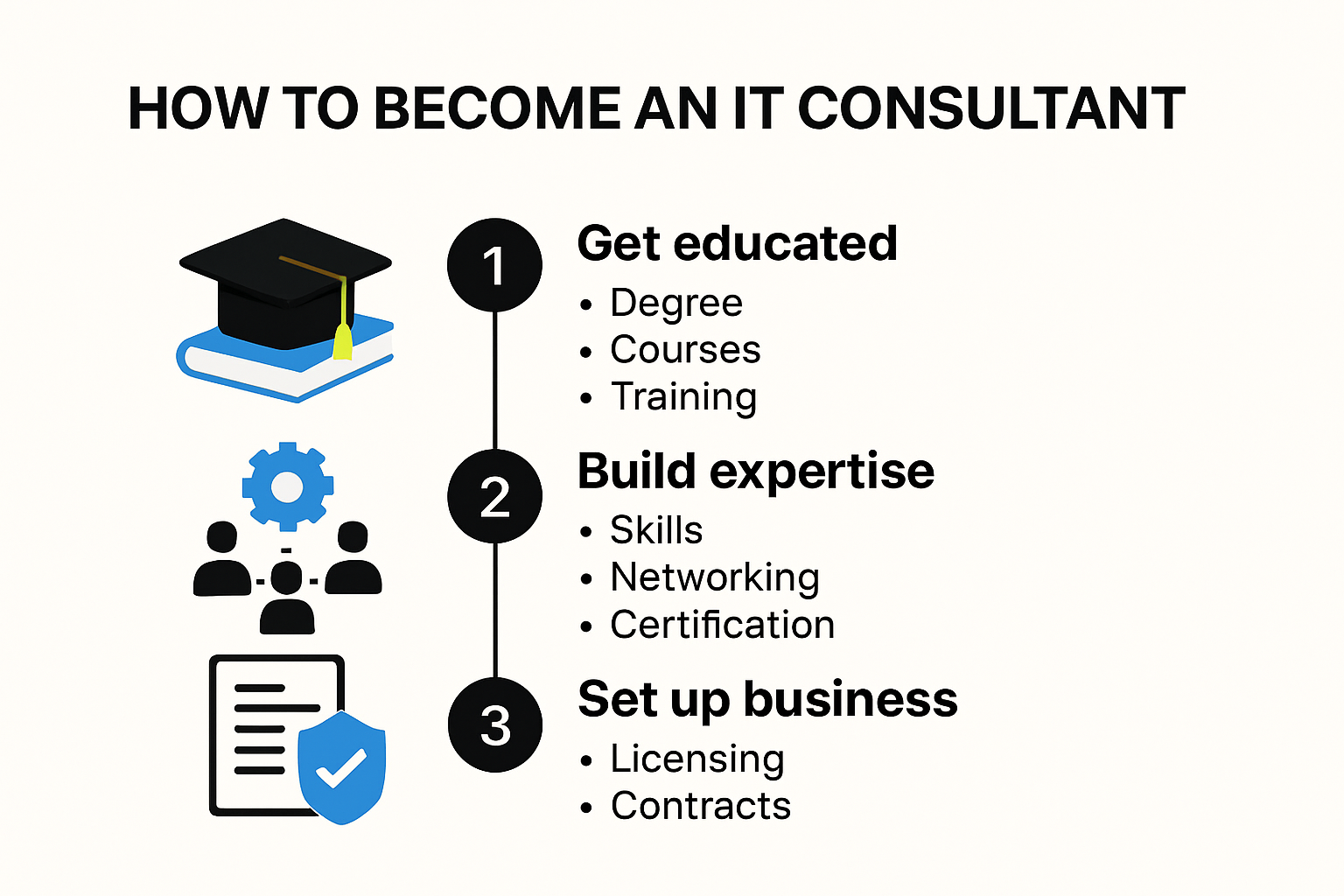
Launching a successful IT consulting career requires strategic planning, deliberate skill development, and a methodical approach to professional growth. The journey from technical professional to sought-after IT consultant involves multiple critical stages of preparation and positioning.
Educational and Technical Foundation
Building a robust consulting career starts with establishing a strong educational background. According to research from leading educational platforms, pursuing a bachelor’s degree in computer science, information technology, or related technical disciplines provides the critical foundational knowledge necessary for consulting success.
Beyond formal education, professionals must focus on developing a comprehensive technical skill set. This involves:
Mastering multiple programming languages
Understanding complex system architectures
Developing proficiency in emerging technologies
Gaining hands-on experience through practical projects
Certifications play a crucial role in demonstrating specialized expertise. Industry-recognized credentials like Certified Information Systems Security Professional (CISSP), Project Management Professional (PMP), and cloud certification programs from major providers validate a consultant’s technical capabilities and commitment to professional development.
Professional Experience and Skill Refinement
Transitioning into consulting requires strategic career progression. Professionals can prepare by gaining entry-level IT roles such as support specialist, IT assistant, or software engineer. These positions provide invaluable opportunities to:
Develop practical technical skills
Understand complex organizational dynamics
Build professional networks
Gain exposure to diverse technological challenges
Consultants must also cultivate soft skills that differentiate them in a competitive market. This includes developing strong communication abilities, strategic problem-solving skills, and the capacity to translate technical concepts for non-technical stakeholders.
Strategic Career Positioning and Networking
Successful consulting careers are built on more than technical skills. Professionals must strategically position themselves by:
Creating a compelling professional portfolio
Developing a robust personal brand
Building strategic industry connections
Demonstrating thought leadership through publications, speaking engagements, and online presence
Networking remains a critical component of consulting success. Attend industry conferences, participate in professional associations, and leverage platforms like LinkedIn to connect with potential clients and industry peers.
Learn more about transitioning into independent consulting with our comprehensive professional guide.
Building a successful IT consulting career is a deliberate, continuous journey of learning, adaptation, and strategic positioning. By combining technical excellence, professional experience, and strategic networking, IT professionals can transform their careers and establish themselves as valuable consulting professionals in the dynamic technology landscape.
To help clarify the path to launching an IT consulting career, the following table summarizes the key stages and primary activities at each step mentioned in this section.
Certifications and Credentials for IT Consultants
In the competitive landscape of IT consulting, professional certifications serve as critical differentiators that validate technical expertise, demonstrate commitment to professional development, and enhance marketability. Strategically selected credentials can significantly elevate a consultant’s professional profile and open doors to advanced opportunities.
Technical and Security Certifications
Technical certifications represent the cornerstone of an IT consultant’s professional credentials. According to industry data, the Certified Information Systems Security Professional (CISSP) stands out as a globally recognized credential. As of July 2022, there were 156,054 CISSP holders worldwide, with 95,243 in the United States and 6,842 in Canada, underscoring its significance in the IT security domain.
Key technical certifications include:
- Cloud Certifications
: Amazon Web Services (AWS), Microsoft Azure, Google Cloud Professional
- Cybersecurity Credentials
: CISSP, CompTIA Security+, Certified Ethical Hacker
- Network Certifications
: Cisco Certified Network Professional (CCNP), Network+
- Programming Certifications
: Oracle Certified Professional, Microsoft Certified: Azure Developer
These certifications demonstrate not just technical knowledge, but a commitment to staying current in rapidly evolving technological landscapes.

Professional and Management Credentials
Beyond technical skills, management and professional certifications provide crucial credibility. The Certified Management Consultant (CMC) represents a pinnacle of professional recognition, requiring rigorous examination of a consultant’s experience, education, and adherence to professional standards.
Notable professional credentials include:
- Business Analysis
: Certified Business Analysis Professional (CBAP)
- Project Management
: Project Management Professional (PMP)
- IT Service Management
: Information Technology Infrastructure Library (ITIL) Certification
- Enterprise Architecture
: The Open Group Architecture Framework (TOGAF)
These certifications demonstrate an ability to bridge technical capabilities with strategic business understanding, a critical skill for successful IT consultants.
Strategic Certification Selection and Career Impact
Selecting certifications requires a strategic approach aligned with career goals and market demands. Professionals should consider:
Current and emerging technological trends
Specific industry sector requirements
Personal career trajectory
Potential return on investment for certification costs
Learn more about navigating your consulting career transition and understanding how certifications can accelerate your professional development.
Ultimately, certifications are more than just credentials. They represent a consultant’s dedication to continuous learning, professional excellence, and staying at the forefront of technological innovation. By carefully curating a portfolio of relevant, high-value certifications, IT consultants can distinguish themselves in a competitive marketplace and demonstrate their commitment to delivering exceptional value to clients.
The table below presents a summary of key IT consulting certifications listed in the article, grouped by category, to help readers compare options for credentialing.
Setting Up Your Consulting Business Legally
Establishing a legally compliant consulting business requires careful planning, strategic decision-making, and a comprehensive understanding of regulatory requirements. Navigating the legal landscape is crucial for protecting your professional interests and creating a solid foundation for sustainable business growth.
Business Structure Selection
According to the Internal Revenue Service (IRS), selecting an appropriate business structure is the first critical step in legally establishing your consulting enterprise. Each business structure offers distinct advantages and implications for taxation, liability, and operational complexity.
Common business structures for IT consultants include:
- Sole Proprietorship
: Simplest structure with minimal administrative requirements
- Limited Liability Company (LLC)
: Provides personal asset protection and flexible tax treatment
- S Corporation
: Offers potential tax advantages and shareholder protections
- Partnership
: Suitable for consultants working collaboratively
Professionals must carefully evaluate their specific circumstances, long-term business goals, and potential risk exposure when choosing a business structure. Consulting with a legal professional or tax advisor can provide personalized guidance tailored to individual needs.
Tax Registration and Compliance
In Canada, entrepreneurs must register their business with the Canada Revenue Agency (CRA), obtaining a Business Number (BN) and adhering to federal and provincial tax regulations. Similarly, in the United States, consultants must secure an Employer Identification Number (EIN) from the IRS.
Key tax and regulatory considerations include:
Registering for Goods and Services Tax (GST) or Harmonized Sales Tax (HST)
Understanding self-employment tax obligations
Maintaining accurate financial records
Establishing a separate business bank account
Implementing robust accounting practices
Licensing and Professional Requirements
Local regulations may mandate additional licenses or permits depending on specific consulting services. Professionals must conduct thorough research to ensure comprehensive legal compliance.
Essential steps for legal and professional compliance include:
Verifying industry-specific licensing requirements
Obtaining necessary professional certifications
Securing appropriate business insurance
Developing comprehensive service contracts
Establishing clear professional liability protections
Explore our comprehensive guide to transitioning into independent consulting for more detailed insights into legal considerations.
Successful legal establishment of a consulting business requires a proactive, strategic approach. By understanding and meticulously addressing regulatory requirements, IT consultants can create a robust legal framework that supports professional growth, minimizes risk, and positions their business for long-term success. Continuous education and professional guidance remain essential in navigating the complex legal landscape of independent consulting.
Frequently Asked Questions
What skills are essential to become an IT consultant in North America?
To succeed as an IT consultant in North America, essential skills include deep technical mastery in areas like cloud computing and cybersecurity, strong communication capabilities to translate technical concepts into business context, and adaptability for continuous learning to keep up with industry trends.
What educational background is required to start a career as an IT consultant?
A bachelor’s degree in computer science, information technology, or a related field is commonly required. Additionally, relevant certifications such as CISSP or PMP can significantly enhance your credibility and marketability in the consulting field.
How can I effectively network in the IT consulting industry?
To network effectively, attend industry conferences, participate in professional organizations, and engage on platforms like LinkedIn. Building a robust personal brand and showcasing your expertise through publications or speaking engagements can also attract valuable connections and opportunities.
What legal steps do I need to take to set up my IT consulting business?
To establish your IT consulting business legally, select an appropriate business structure (e.g., LLC or sole proprietorship), register for necessary tax IDs, ensure compliance with local licensing requirements, and obtain any necessary certifications. Consulting with a legal professional can help navigate these steps.
Ready to Make Your Solo Consulting Leap? Let Real-World Tools Guide You
You have read how mastering technical skills, communication, and business acumen are absolutely necessary for IT consultants in the USA and Canada. But knowing the steps is not enough. The biggest challenge for many professionals is how to confidently make the jump from a steady job to running a thriving, independent consulting business. Fears of making mistakes, missing legal steps, or not finding clients are common barriers.
Imagine if you could access proven advice and step-by-step resources from someone who has already built a successful consulting practice in North America. If you want tested frameworks, practical templates, and motivational support that truly relate to your journey, it is time to go beyond theory.
Take action today. Visit The Consultant’s Compass and discover how the bestselling guide, “Becoming a Solo Consultant – The Consultant’s Compass,” and its 8 exclusive bonuses can help you launch your consulting career with confidence. These tools are designed to help you set up legally, avoid costly errors, and build a business with real freedom and income. Check out our transition guide for IT professionals or go straight to our landing page to claim your fresh start now.
Recommended Articles
- Remote Consulting Explained: A Guide for IT Pros in Canada & USA 2025
- Transition to Consulting: A Guide for IT Professionals Canada & USA 2025
- Independent Consultant Meaning for IT Professionals (2025 Guide)
- Becoming a Solo Consultant
- Pricing Consulting Services: A Guide for IT Professionals Canada & USA 2025
- Strategic Planning Consulting for IT Pros: Canada & USA 2025


Часом знаходжу ці джерела випадково, іноді хтось скине в чат, іноді сам зберігаю “на потім”. Частину переглядаю рідко, частину — коли шукаю щось локальне чи нестандартне. Вони різні: новини, огляди, думки, регіональні стрічки. Я не беру все за правду — скоріше, для порівняння та пошуку контрасту між подачею. Можливо, хтось іще знайде серед них щось цікаве або принаймні нове. Головне — мати з чого обирати. Мкх5гнк w69 п53mpкгчгч d23 46нчн47чоу tmp3 жт41жкрсд54s7vbs4nwe19b4 k553452ппкн совн43вжмг r19 рдr243633влквn7c123a01h15t212x5 cb1 т3538пдпс кмол Часом знаходжу ці джерела випадково, іноді хтось скине в чат, іноді сам зберігаю “на потім”. Частину переглядаю рідко, частину — коли шукаю щось локальне чи нестандартне. Вони різні: новини, огляди, думки, регіональні стрічки. Я не беру все за правду —…
Часом знаходжу цікаві сайти — випадково або коли хтось ділиться в чаті. Частину зберігаю про запас, іноді повертаюсь до них при нагоді. Тут є різне — новини, блоги, локальні стрічки чи просто незвичні штуки. Деякі переглядаю рідко, деякі — коли хочеться вийти за межі звичних джерел. Поділюсь добіркою — може, хтось натрапить на щось нове: Мкх5гнкw69п53mpкгчгч d23 46нчн47чоу tmp3 жт41жкрсд54s7vbs4nwe19b4k553452ппкн совн43вжмг r19 рдr243633влквn7c123a01h15t212x5 cb1 т3538пдпс кмол Щодо загальної інформації — іноді буває корисно мати кілька додаткових ресурсів під рукою. Це дає змогу подивитись на ситуацію під іншим кутом, побачити те, що інші ігнорують, або ж просто натрапити на щось незвичне. Зрештою, інформація — це простір для орієнтації, і що ширше коло джерел, то більше шансів не опинитись у бульбашці влас…