


Consultant Income Potential for IT Pros: 2025 Guide (Canada & USA)


Consultant income for IT professionals is climbing at a surprising pace in North America. Some seasoned consultants in the US now earn over $113,800 each year, while those in Canada are pulling in a strong median of $95,000. It might sound like formal degrees or big city offices are the surest ticket to these top rates. But what is really turning the tables for 2025 is skill mastery and the freedom to consult for clients anywhere, not just in your own backyard. The secret is out for tech pros who want to break past old earning ceilings.
Table of Contents
Quick Summary
Takeaway | Explanation |
Education and experience influence earnings significantly | Advanced degrees and relevant experience equate to higher consulting rates and income potential. |
Specialization in niche areas is crucial | Focus on high-demand technology fields like AI and cybersecurity to attract premium rates. |
Remote work expands consulting opportunities | IT professionals can access a global client base, enhancing income potential beyond regional limits. |
Develop diverse income streams for stability | Create multiple revenue channels, including training and digital products, to mitigate risk and grow income. |
Strong client relationships and project management are essential | Clear communication and defined project scopes significantly enhance client satisfaction and income potential. |
What Impacts Consultant Income Potential?
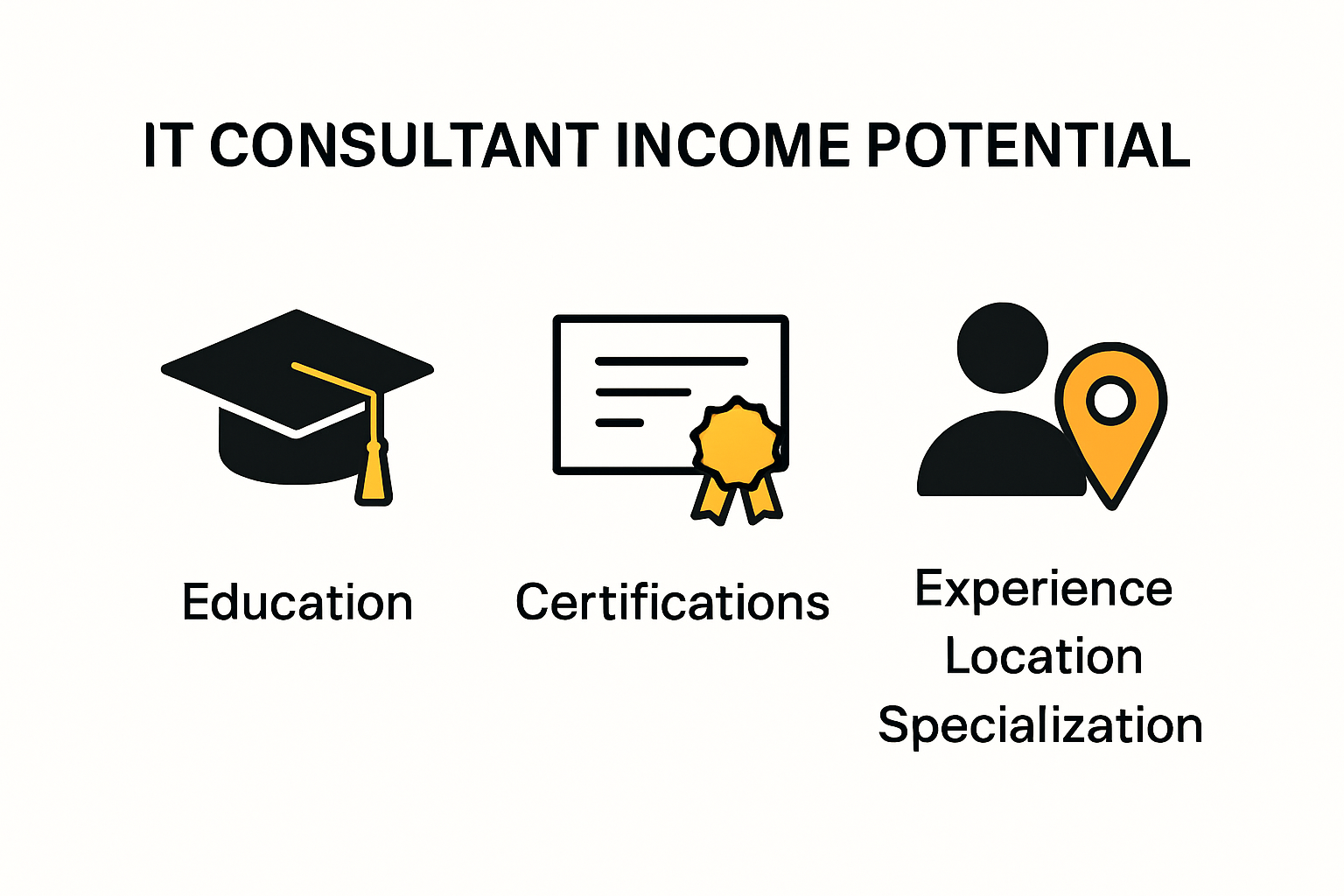
Successful IT consultants understand that income potential is not a static figure but a dynamic equation influenced by multiple strategic factors. While technical skills form the foundation, several critical elements determine your earning capacity in the competitive consulting marketplace.
Education and Credentials Matter
Your educational background plays a significant role in defining your consultant income potential. Coursera’s comprehensive 2025 research reveals a clear correlation between educational attainment and earning power. Professionals with advanced degrees consistently command higher consulting rates. For instance, consultants with a bachelor’s degree average $89,049 annually, while those holding a master’s degree earn $96,488, and doctorate holders can reach $100,889.
Beyond traditional academic credentials, specialized certifications can substantially boost your market value. Certifications in emerging technologies like cloud computing, cybersecurity, and artificial intelligence demonstrate expertise and justify premium consulting rates. Invest in continuous learning and strategic certification pathways to differentiate yourself in a crowded marketplace.
Professional Experience Drives Income
Experience remains the most potent determinant of consultant income potential. Research.com’s salary analysis highlights a dramatic progression in earnings based on professional tenure. Entry-level IT consultants typically start around $65,001 annually, while seasoned professionals with over 15 years of experience can command up to $113,872 per year.
This income trajectory underscores the importance of strategic career development. Each project, client interaction, and successful implementation builds your professional narrative. Document your achievements, cultivate a robust portfolio, and continuously refine your expertise in high-demand technology domains. Specialization in niche areas like enterprise architecture, cloud migration, or cybersecurity strategy can exponentially increase your consulting rates.
Geographic and Market Dynamics
Location plays a nuanced role in determining consultant income potential. TalentGenius.io research demonstrates that geographic markets significantly influence earning potential. Major technology hubs like Silicon Valley, New York City, and Toronto offer substantially higher consulting rates due to concentrated tech ecosystems and elevated living costs.
However, geographic constraints are increasingly fluid with the rise of remote work. Skilled IT consultants can now leverage global marketplaces, accessing clients and projects beyond traditional regional boundaries. Develop a strong online presence, build a compelling digital portfolio, and position yourself as a location-independent technology expert capable of delivering value across diverse markets.
Smart IT professionals recognize that consultant income potential is a multifaceted outcome. By strategically developing your educational credentials, accumulating meaningful professional experience, and understanding market dynamics, you can systematically enhance your earning capacity. The most successful consultants view their career not as a job, but as a continuous investment in professional growth and strategic market positioning.
Here is a table summarizing how education and experience levels impact consultant income potential, based on data provided in this section:
Level | Education/Credentials | Annual Income (USD) | Notes |
Entry-level | Bachelor’s Degree | $89,049 | Avg. annual salary with bachelor’s degree |
Experienced | Master’s Degree | $96,488 | Avg. annual salary with master’s degree |
Highly Experienced | Doctorate Degree | $100,889 | Avg. annual salary with doctorate |
Entry-level IT Consultant | Any Degree | $65,001 | Typical start for early-career consultants |
Senior IT Consultant | 15+ Years Experience | $113,872 | Top tier for seasoned professionals |
Comparing Earnings in Canada and USA
IT consulting presents unique financial opportunities across Canada and the United States, with nuanced differences in earning potential that reflect regional economic landscapes, technology ecosystems, and market demands.
Median Earnings and Regional Variations
In Canada, IT consultants demonstrate a robust earning profile. According to the Canadian Job Bank, the median hourly wage for IT consultants stands at $45.67, translating to an annual salary of approximately $95,000. This figure represents a solid baseline for professionals operating in the Canadian technology marketplace.
Conversely, the United States presents a more diverse earnings landscape. Research from Zippia reveals significant state-level variations. Washington state leads with the highest average IT consultant salary at $113,901, while Hawaii represents the lower end of the spectrum at $57,824. These variations highlight the critical importance of geographic positioning in determining consulting income potential.
To help readers quickly compare IT consultant earnings in Canada and the US, the following table summarizes median and regional salary variations mentioned in this section:
Region / State | Median/Avg. Annual Income (USD) | Notes |
Canada (National) | $95,000 | Median salary based on Job Bank data |
USA (Washington) | $113,901 | Highest average salary in US |
USA (Hawaii) | $57,824 | Lower end of US salary spectrum |
USA (General) | Wide variability | State-level differences can be significant |
Technology Ecosystem Impact
The earning differential between Canada and the USA stems primarily from the scale and density of their respective technology ecosystems. Major metropolitan areas like Toronto, Vancouver, San Francisco, and Seattle serve as technology innovation hubs, offering substantially higher compensation for specialized IT consulting services.
Canadian technology markets tend to be more concentrated, with Toronto and Vancouver serving as primary technology centers. These regions offer competitive rates but generally demonstrate more conservative compensation structures compared to their U.S. counterparts. The United States, with its larger technology infrastructure and more numerous venture capital ecosystems, frequently provides more aggressive compensation packages for specialized consulting expertise.
Factors Influencing Cross-Border Earnings
Multiple factors contribute to the earnings variations between Canadian and American IT consultants. Exchange rates, tax structures, healthcare systems, and local market dynamics play significant roles in net compensation. U.S. consultants often face higher healthcare costs but potentially lower tax burdens, while Canadian consultants benefit from more comprehensive social support systems.
Specialization remains the most critical determinant of earning potential in both markets. Consultants focusing on emerging technologies like artificial intelligence, cloud infrastructure, cybersecurity, and blockchain command premium rates regardless of national boundaries. The most successful IT consultants develop a global perspective, leveraging remote work opportunities and international client bases to optimize their earning potential.
Smart IT professionals recognize that geographic location represents just one component of a comprehensive earning strategy. By developing specialized expertise, maintaining a flexible professional approach, and understanding regional market nuances, consultants can strategically position themselves for maximum financial success in the North American technology consulting landscape.
Trends Shaping 2025 Consulting Salaries

The landscape of IT consulting salaries is undergoing unprecedented transformation, driven by technological disruption, evolving workforce dynamics, and emerging skill requirements. Understanding these trends is crucial for professionals seeking to maximize their earning potential in the rapidly changing technology marketplace.
Skills Over Credentials
Traditional hiring paradigms are experiencing a radical shift. Recent research analyzing job market data reveals a compelling trend where employers are prioritizing specific skills over formal educational credentials. In the AI and technology sectors, skill proficiency is commanding a significant wage premium. The study found that AI-related roles saw a 21% growth in job postings, while mentions of university education requirements declined by 15%.
This trend signals a fundamental reimagining of professional value. Consultants who can demonstrate practical expertise, particularly in emerging technologies like artificial intelligence, cloud computing, and cybersecurity, will command higher rates regardless of their academic background. The ability to deliver tangible results now outweighs traditional qualifications.
Talent Scarcity and Compensation Strategies
The Hays 2021 U.S. Salary Guide highlighted a critical market dynamic: 74% of employers are experiencing skills shortages, with 69% of IT employers reporting moderate-to-extreme talent gaps. To address these challenges, companies are implementing aggressive compensation strategies. Approximately 31% of employers are planning salary increases of 3-5% to attract and retain top talent.
This talent scarcity creates a unique opportunity for skilled IT consultants. Organizations are willing to pay premium rates for professionals who can solve complex technological challenges. Specialization in niche areas like cloud migration, cybersecurity architecture, and AI implementation becomes increasingly valuable. Explore how independent consulting trends are evolving to position yourself strategically in this competitive marketplace.
Remote Work and Global Talent Markets
The rise of remote work has fundamentally transformed consulting compensation models. Geographic limitations are becoming increasingly irrelevant as companies embrace global talent acquisition. IT consultants can now compete for projects worldwide, leveraging digital platforms that connect skilled professionals with international clients.
This global marketplace creates both opportunities and challenges. Consultants must differentiate themselves through a combination of technical expertise, communication skills, and the ability to deliver results in virtual environments. Building a robust online portfolio, maintaining an updated professional network, and continuously upgrading technical skills become essential strategies for success.
The most successful IT consultants in 2025 will be those who view their career as a dynamic, continuous learning journey. By staying ahead of technological trends, developing specialized expertise, and maintaining flexibility in their professional approach, they can navigate the complex and rewarding landscape of technology consulting.
The future of consulting salaries is not just about technical skills but about adaptability, continuous learning, and the capacity to deliver innovative solutions in an increasingly complex technological ecosystem.
How IT Professionals Can Maximize Consultant Income
Maximizing consultant income requires a strategic approach that goes beyond technical expertise. Successful IT professionals understand that income optimization involves a comprehensive strategy encompassing skill development, client management, and innovative revenue generation techniques.
Strategic Service Positioning
Effective consultant income maximization begins with strategic service positioning. Pricing consulting services requires a nuanced approach that balances market demand with your unique value proposition. Consultants must develop a clear understanding of their specialized skills and the specific problems they solve for clients.
Specialization is key to commanding premium rates. Instead of offering generic IT services, focus on niche areas with high market demand. Emerging technologies like artificial intelligence, cloud security, and advanced data analytics present lucrative opportunities for consultants willing to develop deep expertise. By positioning yourself as an expert in a specific technological domain, you can justify higher consulting rates and attract more discerning clients.
Diversifying Income Streams
Research on financial management for consultants emphasizes the importance of diversifying income sources. Relying on a single client or project type introduces significant financial risk. Successful IT consultants create multiple revenue channels that provide stability and growth potential.
Diversification strategies might include:
Offering tiered consulting services
Developing digital products like online courses or e-books
Creating recurring revenue through maintenance contracts
Providing training and workshops
Developing passive income through technical writing or content creation
Exploring various consulting income streams allows professionals to build a more resilient and profitable consulting practice.
To illustrate how IT consultants can diversify their income, here’s a summary of possible income streams based on the points in this section:
Income Stream | Description | Benefit |
Tiered Consulting Services | Offer basic to premium consulting packages | Broader client reach |
Digital Products | Sell online courses, e-books, etc. | Passive revenue potential |
Maintenance Contracts | Recurring support & service agreements | Stable recurring income |
Training & Workshops | Deliver educational sessions to clients or teams | Reputation & extra revenue |
Technical Writing/Content | Produce articles, guides, or resources | Passive or supplementary pay |
Client Relationship and Project Management
According to expert insights from CIO, establishing clear project objectives and maintaining robust client communication are critical for maximizing consulting income. Successful consultants invest time in defining precise project scopes, setting realistic expectations, and demonstrating tangible value.
Key strategies for effective client management include:
Conducting thorough initial consultations
Developing comprehensive project proposals
Implementing regular progress reporting
Maintaining transparent communication channels
Consistently delivering measurable results
Additionally, continuously investing in skill development ensures you remain competitive. Technologies evolve rapidly, and consultants who proactively update their expertise can command higher rates and attract more sophisticated clients.
The most successful IT consultants view their practice as a dynamic business requiring constant innovation, strategic positioning, and a commitment to delivering exceptional value. By combining technical excellence with smart business practices, IT professionals can create a consulting career that offers both financial rewards and professional satisfaction.
Frequently Asked Questions
What is the average consultant income for IT professionals in Canada and the USA?
The median income for IT consultants in Canada is approximately $95,000, while in the USA, seasoned consultants can earn over $113,800 annually depending on their experience and location.
How does experience influence the income potential of IT consultants?
Experience significantly impacts income potential. Entry-level IT consultants can start around $65,001, while those with over 15 years of experience can command salaries up to $113,872 per year.
What skills are in high demand for IT consulting in 2025?
Specializations in emerging technologies such as artificial intelligence, cybersecurity, and cloud computing are crucial for IT consultants to demand premium consulting rates and enhance their income potential.
How can IT professionals maximize their income as consultants?
IT professionals can maximize their income by strategically positioning their services in high-demand niches, diversifying income streams, and maintaining strong client relationships to ensure repeat business.
Ready to Unlock Your Consulting Income Potential?
Are you feeling stuck trying to reach those six-figure consulting rates you read about in the guide? If terms like “skills over credentials,” “strategic service positioning,” and “income maximization” hit close to home, you are not alone. Many IT professionals try to break into solo consulting but quickly run into worries about unclear rates, unpredictable income streams, or simply not knowing where to start.

This is where The Consultant’s Compass steps in. Built by an experienced consultant who has faced these exact barriers, our platform offers clear step-by-step resources, like our bestselling guide and practical tools for new consultants. Get proven frameworks for pricing, winning clients, and protecting your business with trusted contract clauses. Take control of your earning power and avoid mistakes that hold most professionals back. Start your journey today by exploring the no-nonsense strategies at The Consultant’s Compass or dive deeper into pricing consulting services. Your future as a confident and well-paid consultant can start right now with the right support.
Recommended
Comments