


Finding Your First Client: Guide for IT Professionals in Canada and USA
- Carlos Perez Alviarez

- Aug 19, 2025
- 9 min read
Updated: Aug 22, 2025

Landing your first IT client in Canada or the US can feel like searching for a needle in a digital haystack. So it might surprise you that over 70 percent of IT professionals secure their initial gigs through personal networks and targeted outreach instead of traditional job sites. The real twist is that building trust online and locally plays a bigger role in clinching your breakthrough contract than any technical certification ever will.
Table of Contents
Quick Summary
Takeaway | Explanation |
Define your ideal client profile clearly. | Understand specific client needs and challenges to effectively target potential clients. |
Leverage professional networks effectively. | Use platforms like LinkedIn for proactive outreach and to build valuable connections in your industry. |
Build a strong digital portfolio. | Showcase your skills and past project successes to build credibility and attract prospective clients. |
Engage actively with local tech communities. | Participate in networking events and professional associations to create relationships that can lead to opportunities. |
Create a consistent personal brand online. | Maintain uniform profiles across social media and professional platforms to enhance your visibility and trustworthiness. |
Understanding Your Ideal Client Profile
Finding your first client as an IT professional requires more than technical skills. You need a crystal clear understanding of who your ideal client is and what specific problems they need solved. The difference between success and struggle often lies in how precisely you can define and target your potential clients.
Defining Your Client Segmentation Strategy
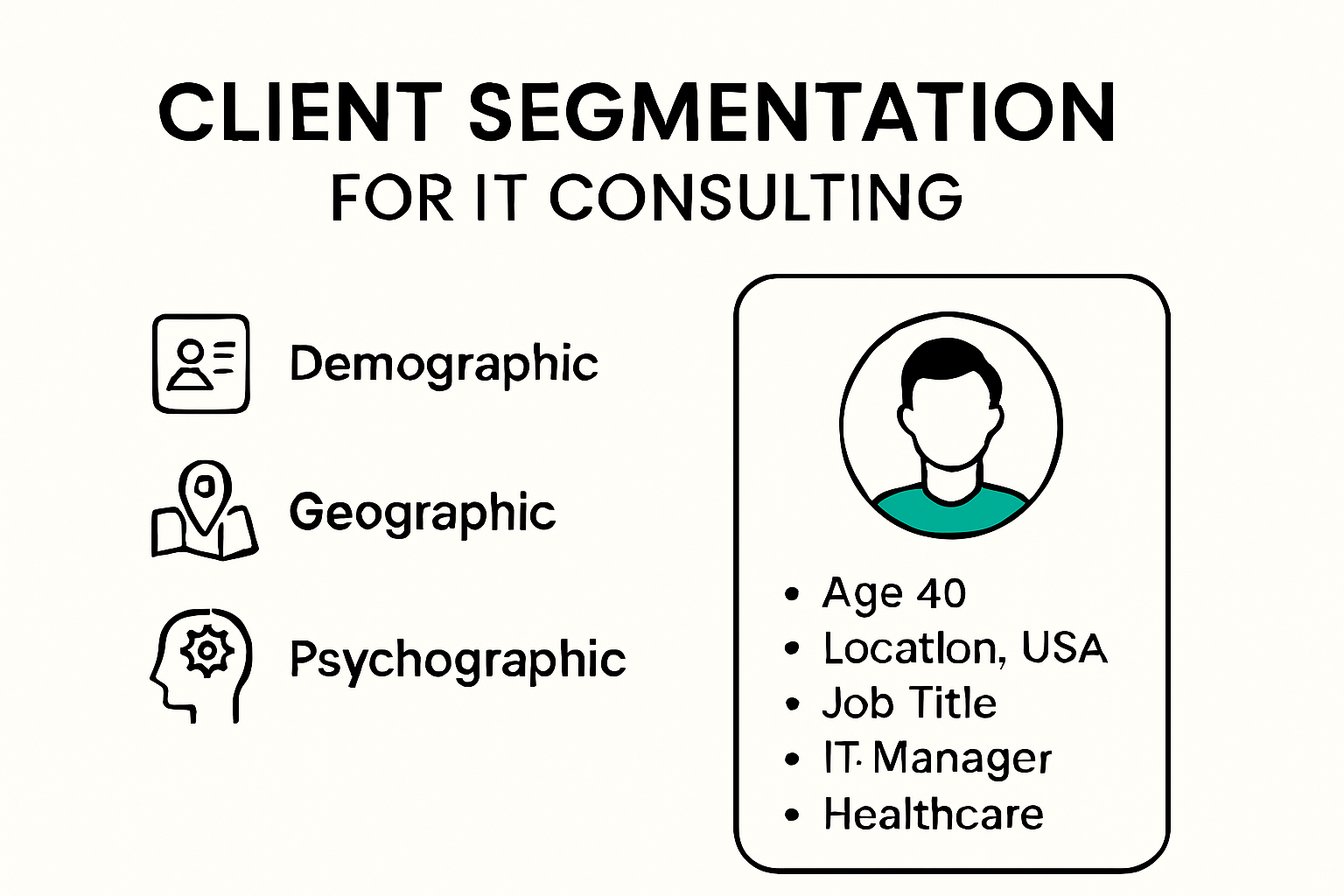
Client segmentation is not about casting a wide net but strategically identifying the most promising opportunities. The U.S. Small Business Administration recommends breaking down potential clients into three key dimensions: demographic, geographic, and psychographic segments.
Demographic considerations for IT professionals include:
Company size (startups, small businesses, enterprises)
Industry vertical (healthcare, finance, technology)
Current technological infrastructure
Budget constraints and investment capacity
Geographic factors play a significant role in defining your client profile. While digital services can transcend physical boundaries, local market nuances matter. Some IT professionals focus on regional markets with specific technological ecosystems or industries clustered in particular areas.
To help you understand common client segmentation factors for IT professionals in Canada and the USA, the table below summarizes key demographic and geographic considerations and provides examples of each.
Segmentation Dimension | Consideration | Example |
Demographic | Company size | Startups, small businesses, enterprises |
Demographic | Industry vertical | Healthcare, finance, technology |
Demographic | Technology infrastructure | Legacy systems, cloud-native, hybrid |
Demographic | Budget & investment capacity | Limited budgets, growth phase, enterprise |
Geographic | Regional tech ecosystem | Focus on cities with tech clusters |
Geographic | Industry location clusters | Financial firms in Toronto, tech in Vancouver |
Geographic | Local market nuances | Specific compliance/regulatory requirements |
Conducting Strategic Market Research
Academic research from enterprise management studies emphasizes the critical importance of evidence-based client profiling. This means moving beyond assumptions and gathering concrete data about potential client needs.
Effective market research involves:
Below is a summary table outlining effective market research methods for IT professionals, describing each method and its main purpose as discussed in the article.
Market Research Method | Description | Main Purpose |
Analyzing industry reports | Study sector-specific reports | Identify market trends and demands |
Conducting informational interviews | Speak directly with industry professionals | Gather qualitative, client-focused insights |
Reviewing job postings and trends | Examine market demand for IT roles | Reveal required skills and industry needs |
Understanding business pain points | Assess challenges of target segments | Align value proposition with real needs |
Analyzing industry reports
Conducting informational interviews
Reviewing job postings and market trends
Understanding pain points specific to different business segments
Your goal is not just to find any client but to identify organizations where your specific skill set provides maximum value. For instance, a cybersecurity specialist might target mid-sized financial institutions struggling with regulatory compliance, while a cloud migration expert could focus on traditional companies seeking digital transformation.
Developing Your Unique Value Proposition
Once you’ve defined your ideal client profile, craft a compelling value proposition that speaks directly to their specific challenges. This means translating your technical expertise into tangible business outcomes. Instead of listing technical skills, articulate how you solve critical business problems.
Example: Rather than saying “I provide network security services,” communicate “I help financial services companies reduce cybersecurity risks and ensure regulatory compliance, potentially saving millions in potential breach costs.”
Learn more about strategic client targeting for IT consultants to refine your approach and attract high-value clients who truly need your expertise.
Effective Outreach Strategies for IT Experts
Successfully finding your first client requires strategic and purposeful outreach. IT professionals must go beyond passive job hunting and proactively create opportunities through targeted engagement strategies.
Leveraging Professional Networks and Digital Platforms
According to Duke University’s Career Hub, proactive job search strategies are crucial for professionals seeking new opportunities. Digital platforms offer unprecedented connectivity for IT experts to expand their professional reach.
LinkedIn emerges as a powerful tool for professional networking. Create a compelling profile that highlights your specific IT expertise, showcasing project outcomes and specialized skills. Engage actively by:
Sharing industry insights
Commenting on relevant posts
Connecting with professionals in your target industries
Participating in IT and technology-focused groups
EDUCAUSE Review recommends using strategic hashtags and tagging relevant professional communities to increase visibility. Twitter and other social media platforms can also serve as powerful networking tools when used strategically.
Strategic In-Person and Online Networking
Networking extends beyond digital platforms. The Agency for Healthcare Research and Quality emphasizes the importance of person-to-person interactions and collaborative approaches.
Consider these networking strategies:
Attend industry conferences and technology meetups
Join professional associations related to your IT specialization
Participate in webinars and online workshops
Offer to give presentations or technical talks
Collaborate with complementary professionals who might refer clients
The goal is to position yourself as a knowledgeable and approachable expert who provides genuine value. Build relationships based on mutual professional respect and potential collaboration opportunities.
To make it easier to select networking strategies, the following table compares in-person and online networking methods for IT professionals seeking their first client, highlighting examples and advantages of each.
Networking Approach | Examples | Key Advantages |
In-person Networking | Conferences, meetups, tech seminars | Builds deeper trust and local connections |
Online Networking | LinkedIn groups, webinars, online workshops | Wider reach and scalable engagement |
Hybrid Strategies | Collaborations, joint presentations, virtual events | Combines reach and personal rapport |
Developing a Targeted Outreach Approach
Successful outreach requires a systematic and personalized approach. Research potential clients thoroughly, understanding their specific technological challenges and business objectives. Craft personalized communication that demonstrates your understanding of their unique needs.
Tailored outreach might include:
Sending personalized connection requests
Sharing relevant technical insights
Offering brief consultations
Providing value through informative content
Learn more about strategic client acquisition techniques for IT professionals to refine your approach and increase your chances of securing your first consulting engagement.
Remember, effective outreach is about building genuine relationships, demonstrating expertise, and consistently providing value to potential clients.
Building Trust Through Your Online Presence
In the digital age, your online presence is your professional calling card. For IT professionals seeking their first client, crafting a trustworthy and compelling digital identity is not just recommended—it is essential.
Developing a Professional Digital Portfolio
Walden University emphasizes the critical importance of establishing a professional website that demonstrates credibility and expertise. Your digital portfolio should go beyond a simple resume, showcasing tangible evidence of your technical capabilities.
Key elements of a robust digital portfolio include:
Detailed case studies of past projects
Technical problem-solving demonstrations
Quantifiable achievements and outcomes
Testimonials from previous collaborators or employers
Clear description of your specialized IT skills
Ensure your portfolio is visually clean, professionally designed, and easy to navigate. The goal is to make a strong first impression that communicates competence and reliability.
Managing Your Social Media and Professional Platforms
The Cybersecurity and Infrastructure Security Agency advises professionals to carefully manage their online settings and digital footprint. Your social media profiles are extensions of your professional brand and require strategic curation.
Prioritize professional platforms like LinkedIn, where you can:
Publish thoughtful industry insights
Share technical articles and research
Engage in meaningful professional discussions
Connect with potential clients and industry peers
Demonstrate ongoing learning and technological expertise
Be mindful of privacy settings and the content you share. Potential clients will likely research your online presence before engaging your services.
Consistent Personal Branding Across Digital Channels
EDUCAUSE Review highlights the significance of maintaining a consistent professional narrative across all digital platforms. Your online persona should reflect your unique value proposition as an IT professional.
Strategies for consistent branding include:
Using a professional headshot across platforms
Maintaining a consistent professional bio
Aligning your messaging and tone
Highlighting your specific IT expertise
Demonstrating thought leadership through original content
Discover comprehensive strategies for creating a standout online consulting presence that attracts and converts potential clients.
Remember, building trust online is about authenticity, expertise, and consistently demonstrating value. Your digital presence should tell a compelling story of your professional capabilities and potential as a trusted IT consultant.
Leveraging Local Networks and Tech Communities
Building a successful IT consulting practice requires more than technical skills—it demands strategic networking and active participation in local professional ecosystems. Local networks and tech communities represent powerful platforms for discovering opportunities and establishing credibility.
Identifying and Engaging with Local Tech Communities
According to research from the National Institutes of Health, professional networking through local industry groups significantly enhances opportunities for project collaboration and client engagement among technology professionals. These communities serve as critical pathways for emerging IT consultants to connect with potential clients and peers.
Strategic approaches to engaging local tech communities include:
Attending regular meetups and technology conferences
Participating in local hackathons and innovation challenges
Joining professional associations specific to your IT specialization
Contributing to open-source projects within your regional tech ecosystem
Volunteering for technology education and mentorship programs
Each interaction represents an opportunity to demonstrate expertise, build relationships, and potentially uncover hidden client opportunities. The key is consistent, genuine engagement rather than transactional networking.
Developing Meaningful Professional Relationships
Successful networking transcends mere contact exchange. Focus on creating value for your professional community by:
Sharing technical insights and industry knowledge
Offering peer support and problem-solving advice
Connecting professionals within your network
Presenting at local technology seminars
Writing technical blog posts or articles relevant to your local tech scene
These activities position you as a knowledgeable and collaborative professional, increasing the likelihood of referrals and client recommendations.
Maximizing Digital and In-Person Networking Platforms
Combine digital and physical networking strategies to maximize your reach. Platforms like Meetup, LinkedIn Local, and regional technology Slack channels provide structured opportunities for professional connection.
Consider these multi-channel networking tactics:
Create a robust LinkedIn profile highlighting local community involvement
Join region-specific technology groups on social platforms
Participate in local technology forum discussions
Attend virtual and in-person networking events
Follow and engage with local tech industry leaders and innovators
Explore advanced strategies for finding consulting opportunities in your local tech ecosystem to accelerate your professional growth.
Remember, successful networking is about building genuine relationships, demonstrating consistent value, and positioning yourself as a trusted resource within your local professional community. Your network is your most valuable asset in finding your first—and subsequent—consulting clients.

Frequently Asked Questions
How can I determine my ideal client profile as an IT professional?
To define your ideal client profile, assess the specific needs and problems of potential clients by considering factors such as company size, industry vertical, technology infrastructure, and budget constraints. This helps to tailor your outreach and services effectively.
What are some effective outreach strategies to find my first IT client?
Effective outreach strategies include leveraging professional networks like LinkedIn, participating in industry-specific events and webinars, and conducting personalized outreach by understanding the unique challenges faced by potential clients.
How can I build trust through my online presence as an IT professional?
You can build trust by developing a professional digital portfolio showcasing your skills, managing your social media presence strategically, and maintaining consistent branding across all platforms to reflect your expertise and reliability.
Why is local networking important for IT professionals looking for clients?
Local networking is crucial as it allows IT professionals to connect personally with others in the industry, engage with community tech groups, and create meaningful professional relationships. This can lead to client referrals and opportunities that may not be available online.
Take the Next Step to Secure Your First IT Client
Are you finding it tough to stand out and land your first client in the competitive IT landscape of Canada and the USA? If you have read through proven strategies about defining your ideal client, developing a strong online presence, and building local networks, it is clear that having the right guidance can make all the difference. The frustrations of outreach, hesitation about value proposition, and uncertainty about where to focus your efforts are common challenges for new consultants.
Now is the perfect time to accelerate your consulting career with results-backed support. The Consultant’s Compass offers practical tools, mentorship, and a step-by-step guide that aligns with everything you have learned in this article. Access actionable templates and honest advice so you can avoid costly mistakes and start winning clients faster. Get started by visiting The Consultant’s Compass and explore additional expert resources such as How to Market Consulting as an IT Professional to move forward today.
Recommended
Comments