


Consulting Business Registration for IT Professionals: Canada and USA Guide
- Carlos Perez Alviarez

- Aug 12, 2025
- 9 min read
Updated: Aug 14, 2025

If you work in IT and are considering launching your own consulting business in Canada or the USA, you are not alone. Over 70 percent of new consulting firms encounter registration mistakes that cost them time and money. Most people assume setting up shop is no more than filling out a simple form. Registration actually demands much more planning and strategy than you might expect, and a few small missteps can cause big headaches down the road.
Table of Contents
Quick Summary
Takeaway | Explanation |
Choose the Right Business Structure | Selecting a sole proprietorship, partnership, or corporation is crucial for legal and tax implications. |
Comply with Registration Requirements | Complete necessary registrations at federal, state, and local levels for your consulting business. |
Maintain Accurate Financial Records | Keep detailed financial records for taxes, compliance, and strategic planning. |
Understand Provincial and State Variations | Registration processes differ significantly across Canadian provinces and US states, so verify local rules. |
Avoid Common Registration Mistakes | Ensure correct entity selection, complete documentation, and necessary licensing to prevent costly errors. |
Understanding Consulting Business Registration Basics
Registering a consulting business requires careful planning and strategic decision making for IT professionals. The foundation of a successful consulting venture begins with understanding the legal and administrative requirements that transform your professional expertise into a legitimate business entity.
Legal Structures for Consulting Businesses
Choosing the right business structure is a critical first step in your consulting business registration process. IT professionals typically have three primary options: sole proprietorship, partnership, and incorporation. Learn more about choosing the right business structure for your specific consulting needs.
According to the San Francisco Office of Small Business, each business structure offers distinct advantages and legal implications. A sole proprietorship is the simplest form, where you operate under your personal name and have minimal registration requirements. Partnerships involve two or more individuals sharing business responsibilities and profits. Incorporation provides the most robust legal protection by creating a separate legal entity from the business owner.
To help IT professionals choose the best structure for their consulting business, the table below compares the main legal structures available in both Canada and the USA, highlighting their key characteristics and benefits.
Structure | Ownership Type | Liability Protection | Registration Complexity | Key Benefits |
Sole Proprietorship | Individual | None | Low | Simple setup, low cost |
Partnership | 2+ Individuals | Shared | Moderate | Shared responsibilities |
Corporation / Inc. | Separate Legal Entity | High | High | Limited liability, tax options |
LLC (USA only) | Individual/Partners | High | Moderate | Liability protection, flexible |
S Corporation (USA only) | Up to 100 Shareholders | High | High | Tax savings, attracts investors |
C Corporation (USA only) | Unlimited Shareholders | High | High | Best for larger operations |
Registration and Compliance Requirements
Registering a consulting business involves multiple administrative steps. Nolo highlights several key requirements for IT professionals:
Obtain a Federal Tax ID: Secure an Employer Identification Number (EIN) from the IRS, which is essential for tax purposes and opening business bank accounts.
Business Licensing: Research and acquire general business licenses specific to your consulting services and local jurisdiction.
Name Registration: File a ‘doing-business-as’ (DBA) certificate if operating under a name different from your legal name.
Professional Credentials: Verify if your specific IT consulting services require professional licensing or specialized certifications.
The State of New Jersey’s Starter Kit for IT Consultants emphasizes the importance of comprehensive preparation. This includes developing a detailed business plan, selecting an appropriate business structure, and ensuring all necessary permits and insurance policies are in place.
Professional IT consultants must also consider local zoning laws, especially when operating a home-based business. Some municipalities have specific regulations regarding business operations from residential locations. Additionally, maintaining accurate financial records and understanding tax obligations are crucial for long-term business success.
By carefully navigating the consulting business registration process, IT professionals can establish a solid legal foundation that protects their interests and positions them for sustainable growth in the competitive consulting marketplace.
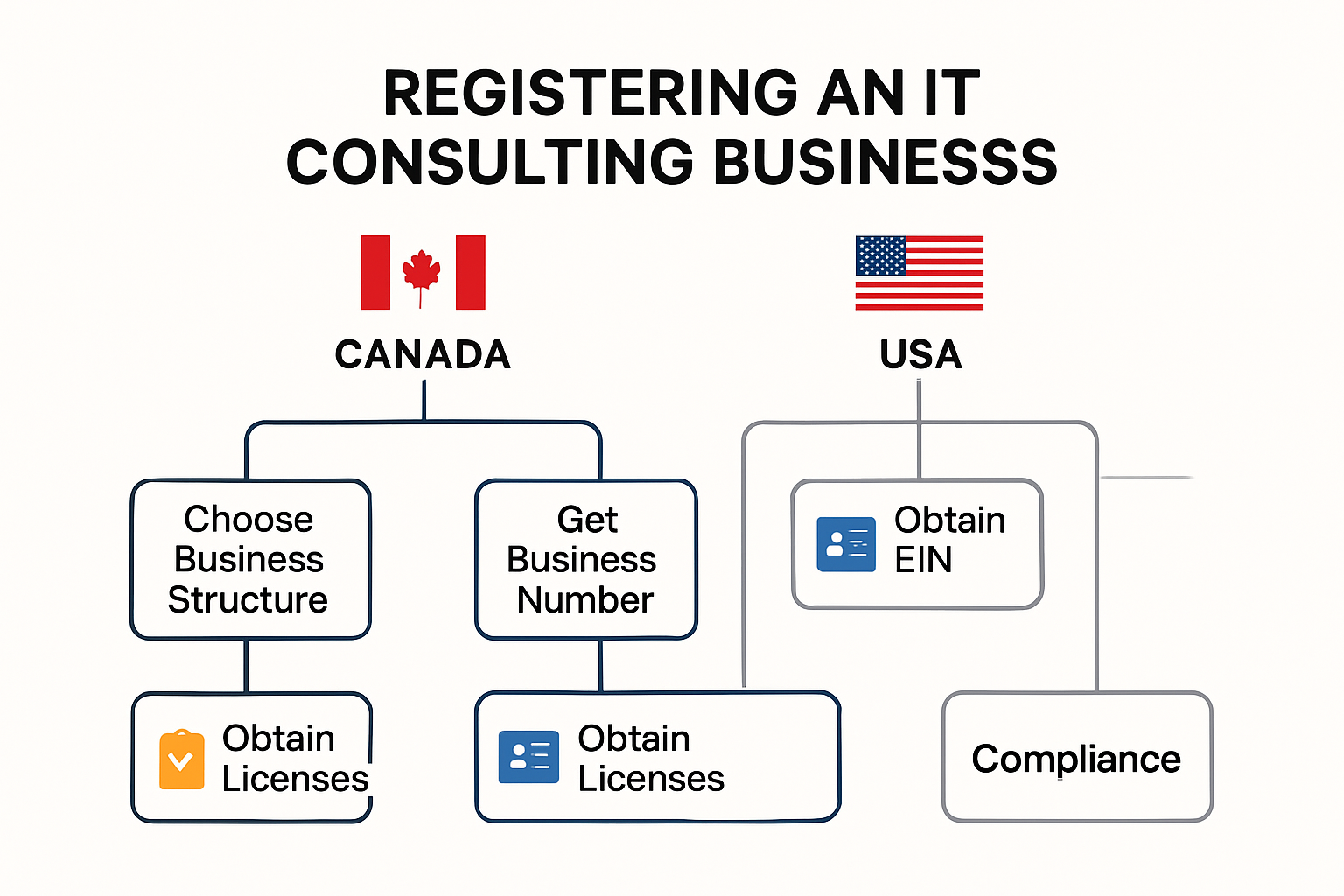
The following table summarizes the key steps IT professionals should follow when registering a consulting business in Canada and the USA. Use this as a reference to ensure important actions are not missed in either country.
Registration Step | Canada | USA |
Select Business Structure | Sole Proprietorship, Partnership, Corporation | Sole Proprietorship, LLC, S Corp, C Corp |
Obtain Federal Tax ID | Business Number (BN) | Employer Identification Number (EIN) |
Register Business Name | Provincial Name Search & Registration | State Name Search & Registration |
Register with Authorities | Provincial Registration | State Secretary of State Registration |
Tax Registration | GST/HST if > $30,000 CAD revenue | State/Federal Tax Registration |
Professional Licensing | Provincial or Industry Certifications | State or City Consulting Licenses |
Secure Permits & Insurance | As required by province/municipality | As required by state/city |
Registration Steps for IT Professionals in Canada
IT professionals in Canada must navigate a structured process to legally establish their consulting business. Understanding the specific registration requirements ensures compliance and sets a strong foundation for a successful independent consulting practice.
Business Structure and Provincial Considerations
The first critical step for Canadian IT consultants is selecting an appropriate business structure. Explore the best consulting business models that align with your professional goals and financial strategy.
According to the Government of Canada, IT professionals have three primary business structure options:
Sole Proprietorship: Simplest structure with minimal registration requirements
Partnership: Shared business responsibilities and potential tax advantages
Corporation: Enhanced legal protection and potential tax benefits
Each province in Canada has unique registration requirements. Alberta, Ontario, and British Columbia have slightly different processes for business registration, making it essential to check local municipal and provincial regulations specific to your operating location.
Federal and Provincial Registration Process
Registering a consulting business in Canada involves multiple administrative steps. Business Development Canada recommends a comprehensive approach to business registration:
Business Number Acquisition: Obtain a Business Number (BN) from the Canada Revenue Agency
GST/HST Registration: Register for Goods and Services Tax if annual revenue exceeds CAD 30,000
Provincial Business Registration: Complete registration with your specific provincial government
Name Search and Registration: Conduct a business name search and register your consulting business name
IT professionals must also secure necessary permits and professional certifications. This might include provincial IT professional licenses, industry-specific credentials, and potential memberships in professional associations that validate your consulting expertise.
Tax and Compliance Considerations
Canadian IT consultants must maintain meticulous financial records and understand tax obligations. This includes tracking business income, managing professional expenses, and preparing for annual tax reporting. Consulting with a Canadian tax professional specializing in small business taxation can provide personalized guidance on maximizing deductions and maintaining compliance.
By methodically following these registration steps, IT professionals can establish a legally sound consulting business in Canada, positioning themselves for sustainable growth and professional success in the competitive technology consulting marketplace.
Registration Steps for IT Professionals in USA
IT professionals in the United States seeking to establish a consulting business must navigate a complex registration process that involves multiple federal, state, and local requirements. Successful registration sets the foundation for a legally compliant and professionally structured consulting venture.
Business Entity Selection and Legal Considerations
Learn the essential steps for launching your IT consulting business before diving into the registration process. According to Wolters Kluwer, IT professionals have several business structure options:
Sole Proprietorship: Simplest structure with minimal administrative requirements
Limited Liability Company (LLC): Provides personal asset protection and tax flexibility
S Corporation: Offers potential tax advantages for small businesses
C Corporation: Suitable for larger consulting operations with multiple stakeholders
Each business structure presents unique legal and tax implications. The choice depends on factors such as liability protection, tax efficiency, and long-term business goals. CorpNet emphasizes the importance of carefully evaluating these options to select the most appropriate structure for your specific consulting practice.
Federal and State Registration Process
Registering a consulting business in the USA involves several critical steps:
Employer Identification Number (EIN): Obtain an EIN from the Internal Revenue Service (IRS)
State Business Registration: Complete registration with your state’s Secretary of State office
Business Name Registration: Conduct a comprehensive business name search and register your consulting business name
Professional Licensing: Verify and obtain any required state-specific IT consulting licenses
NNU Immigration highlights the importance of understanding state-specific requirements. Registration processes can vary significantly between states like California, Texas, and New York, making it crucial to research local regulations thoroughly.
Compliance and Ongoing Requirements
Beyond initial registration, IT consultants must maintain ongoing compliance with various regulatory requirements. This includes:
Maintaining accurate financial records
Filing annual tax returns
Securing appropriate business insurance
Staying current with professional certifications
Complying with local zoning regulations, especially for home-based businesses
Professional consultants should consider consulting with a business attorney or tax professional to ensure full compliance and optimize their business structure. By methodically following these registration steps, IT professionals can establish a solid legal foundation for their consulting business in the United States, positioning themselves for sustainable growth and success in the competitive technology consulting market.
Common Mistakes and Helpful Tips for IT Consulting Firms
Establishing a successful IT consulting firm requires more than technical expertise. Navigating the complex landscape of business registration and compliance demands strategic awareness and proactive planning. Understanding common pitfalls can help professionals avoid costly mistakes and position their consulting business for sustainable growth.
Registration and Legal Compliance Challenges
Explore strategies for successful consulting service delivery to complement your legal foundation. According to the U.S. Small Business Administration, IT consulting firms frequently encounter critical registration errors:
Incorrect Business Structure Selection: Choosing a business entity that does not align with long-term financial and operational goals
Incomplete Documentation: Failing to maintain comprehensive records for tax and legal purposes
Overlooking Professional Licensing: Neglecting state-specific professional certification requirements
Tax Registration Errors: Misunderstanding federal and state tax obligations
The IRS emphasizes the importance of proper classification, particularly distinguishing between independent contractors and employees, which can significantly impact tax liabilities and legal responsibilities.
Financial and Administrative Pitfalls
IT consulting professionals must be vigilant about potential financial and administrative mistakes. Government of Canada highlights several critical areas of concern:
Inadequate financial record-keeping
Insufficient business insurance coverage
Poor cash flow management
Neglecting to separate personal and business finances
Failing to budget for unexpected expenses
Consultants should consider working with professional accountants and financial advisors who specialize in small business and IT consulting sectors. These professionals can provide tailored guidance on tax strategies, financial planning, and compliance requirements.

Strategic Recommendations for Success
To mitigate risks and optimize business registration, IT consulting professionals should:
Conduct thorough research on federal, state, and local registration requirements
Maintain meticulous financial and legal documentation
Invest in continuous professional development and certifications
Develop a comprehensive business plan with clear financial projections
Establish relationships with legal and financial professionals
Regularly review and update business structures and strategies
By proactively addressing potential challenges and maintaining a strategic approach to business registration, IT consulting firms can create a robust legal and financial foundation. This approach not only ensures compliance but also positions the business for long-term growth and success in the competitive consulting marketplace.
Frequently Asked Questions
What are the common legal structures for registering a consulting business in Canada and the USA?
In Canada and the USA, common legal structures include sole proprietorships, partnerships, and corporations. Each structure has distinct advantages and implications for liability and taxes.
What steps are involved in registering a consulting business in Canada?
Key steps include selecting a business structure, obtaining a Business Number (BN), registering for GST/HST if applicable, and conducting a name search to register your consulting business name with provincial authorities.
What compliance requirements must IT consultants follow in the USA?
IT consultants in the USA must obtain an Employer Identification Number (EIN), register their business with the state’s Secretary of State, and may require state-specific professional licenses depending on their consulting services.
What mistakes should IT professionals avoid when registering their consulting business?
Common mistakes include choosing the wrong business structure, not maintaining accurate documentation, overlooking necessary professional licenses, and misunderstanding federal and state tax obligations.
Take Your Consulting Business Registration from Overwhelmed to Confident
Starting your IT consulting business in Canada or the USA can feel confusing. With so many legal structures, tax rules, and province or state requirements, missed steps and costly mistakes are easy to make. If you are worried about choosing the right business structure or keeping up with compliance, know that you are not alone. Many professionals feel stress about setting up their consulting venture the right way while protecting their future income and credibility.
You do not need to navigate this process by yourself. The Consultant’s Compass offers step-by-step tools and trusted guidance to help you register your consulting business correctly from the very beginning. Unlock proven frameworks, calculators, and real-world advice that save you time and help you avoid expensive errors. For a deeper understanding and to set your business on the right path fast, check out our bestselling guide Becoming a Solo Consultant – The Consultant’s Compass, which is packed with practical resources and a Canadian perspective. Visit our website today and start building your consulting business with the clarity and confidence you deserve.
Recommended
Comments