


Consultant Business Models for IT Pros in Canada and USA 2025

IT consulting in Canada and the USA is shifting fast, with consultants expected to deliver more than just advice. Here is the surprise. The IT consulting market in Canada alone is set to hit US$1.56 billion by 2025 and that is not just from classic hourly billing. The big twist is that outcome based and subscription models are reshaping how IT pros earn, connect with clients, and build lasting success. These new strategies could change your whole view of what consulting can be.
Table of Contents
Quick Summary
Overview of Top Consultant Business Models
The IT consulting landscape is rapidly transforming, driven by technological advancements and changing market dynamics. Understanding the most effective consultant business models is crucial for professionals seeking to establish successful independent practices in 2025 and beyond.
Strategic Consulting Model Configurations
Digital technologies are fundamentally reshaping how consulting services are delivered and valued. Emerging research from digital transformation studies reveals that successful consultant business models now require more than traditional advisory approaches. Modern IT consultants must develop adaptive strategies that integrate comprehensive digital solutions.
Key model configurations include:
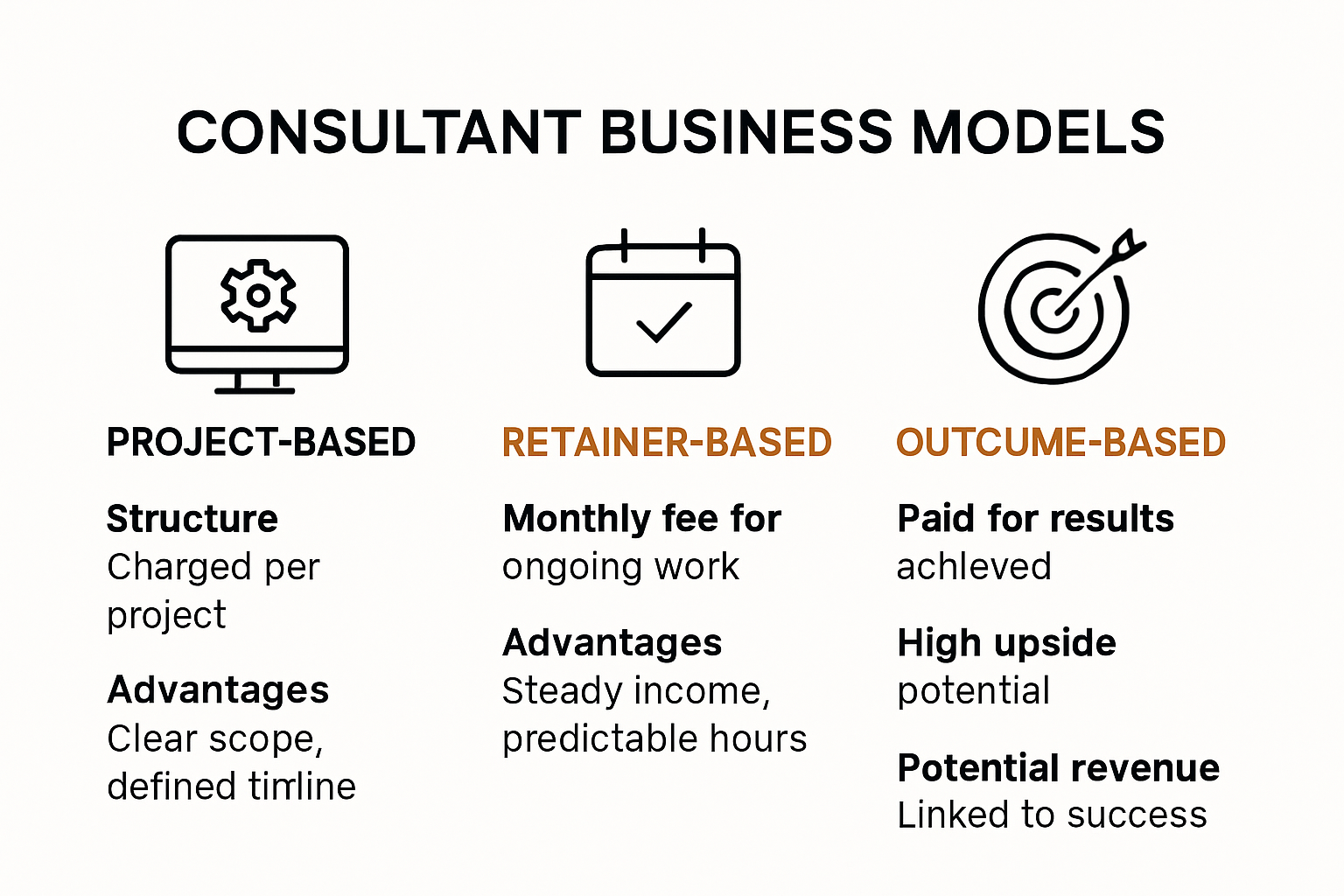
Project Based Consulting: Focused on delivering specific technical solutions with defined scopes and deliverables. This model allows consultants to leverage specialized expertise in targeted areas like cloud migration, cybersecurity implementation, or enterprise software integration.
Retainer Based Engagement: Provides ongoing strategic support where clients pay a recurring fee for continuous technical guidance and problem solving. This model creates predictable revenue streams and enables deeper client relationships.
Outcome Based Consulting: Ties consultant compensation directly to measurable business outcomes, emphasizing value creation over hourly billing. This approach aligns consultant incentives with client success metrics.
Technology Driven Consulting Ecosystems
Management consulting research indicates that top consulting firms are evolving by expanding their digital ecosystems. Successful consultants are no longer just service providers but strategic partners who offer comprehensive technological solutions.
This ecosystem approach involves:

Developing robust digital capabilities
Creating cross-functional technological expertise
Building scalable service platforms
Integrating advanced analytics and AI technologies
Emerging Consulting Business Architecture
Technical research on digital consulting services highlights the critical importance of standardized service frameworks. Modern consultant business models must incorporate:
Flexible service delivery mechanisms
Cross-organizational collaboration tools
Scientific and technical artifact development
Standardized ontological foundations for service description
Professionals looking to develop a comprehensive consulting strategy should focus on adaptability, technological integration, and value-driven service models.
The most successful IT consultants in 2025 will be those who can dynamically blend technological expertise, strategic thinking, and client-centric service delivery. By understanding and implementing these advanced business models, independent consultants can position themselves as indispensable strategic partners in an increasingly complex digital marketplace.
Below is a table summarizing the key consulting business models mentioned in this section for easier comparison.
Comparing Revenue Streams for IT Consultants
Revenue generation for IT consultants has become increasingly complex and diversified in 2025, with multiple strategic approaches emerging to maximize income potential and professional flexibility.
Hourly and Project Based Revenue Models
Canadian market research indicates the IT consulting market is projected to reach US$1.56 billion by 2025, highlighting significant opportunities for professionals who strategically structure their revenue streams. Traditional hourly billing remains a foundational approach, where consultants charge predetermined rates for specific technical work.
Key considerations for hourly and project based revenue include:
Establishing competitive yet fair hourly rates
Clearly defining project scopes and deliverables
Implementing transparent billing mechanisms
Managing project timelines and complexity
Retainer and Subscription Revenue Strategies
Statistical data from industry reports reveals that business clients represent 64.6% of consulting service revenues. Retainer and subscription models have gained substantial traction, offering consultants more predictable income streams.
Advantages of recurring revenue models include:
Consistent monthly income
Enhanced client relationship stability
Reduced time spent on client acquisition
Opportunity for long term strategic partnerships
Performance and Value Based Revenue Approaches
Management consulting research demonstrates the consulting services industry generated $37.8 billion in operating revenue in 2023, with a significant portion attributed to performance driven compensation structures.
Value based revenue strategies focus on:
Linking consultant compensation to measurable outcomes
Creating transparent performance metrics
Aligning consultant incentives with client success
Demonstrating tangible business impact
Professionals looking to optimize their consulting pricing strategy must carefully evaluate these revenue models.
Below is a table comparing the primary revenue stream models for IT consultants as described in the section above.
Successful IT consultants in 2025 will leverage a hybrid approach, combining multiple revenue streams to create a robust and adaptable income strategy. By understanding market dynamics, implementing flexible pricing models, and consistently delivering high value solutions, consultants can build sustainable and profitable practices in an increasingly competitive landscape.
Choosing the Best Model for Your IT Career
Selecting the ideal consultant business model requires careful evaluation of personal strengths, market demands, and long term career objectives. IT professionals must strategically align their consulting approach with their unique skills and professional aspirations.
Personal Skill Assessment and Market Alignment
Research on innovation models highlights the importance of understanding interconnected professional ecosystems. Successful IT consultants must critically assess their technical expertise, soft skills, and potential market opportunities.
Key factors in skill assessment include:

Technical depth and specialization areas
Communication and problem solving capabilities
Industry specific knowledge
Adaptability to emerging technologies
Platform and Network Based Consulting Strategies
Emerging consulting platforms demonstrate the growing importance of flexible, on demand expertise. Modern IT consultants can leverage digital platforms and professional networks to expand their service offerings and client reach.
Strategic considerations for platform based consulting:
Utilizing freelance and consulting marketplaces
Building a robust professional network
Creating digital portfolios showcasing expertise
Developing cross platform professional visibility
Asset and Knowledge Based Consulting Models
Consulting industry research reveals a shift towards asset based consulting models. Professionals can differentiate themselves by developing proprietary tools, methodologies, and intellectual property.
Strategies for building asset based consulting practices:
Developing specialized software or diagnostic tools
Creating standardized consulting frameworks
Documenting and packaging unique methodological approaches
Building reproducible solution architectures
Professionals seeking to accelerate their consulting transition must approach model selection with strategic intentionality.
The most successful IT consultants in 2025 will be those who combine technical excellence with adaptive business models. By continuously reassessing market needs, investing in personal skill development, and remaining flexible in service delivery, IT professionals can create resilient and rewarding consulting careers that evolve with technological and market dynamics.
Adapting Business Models for the Future
The rapidly evolving technological landscape demands continuous transformation of consultant business models. IT professionals must proactively anticipate and integrate emerging technologies and strategic approaches to remain competitive and relevant in 2025 and beyond.
Technology Driven Model Transformation
Research on professional services innovation reveals that outcome-based models are replacing traditional consulting engagement structures. This shift requires consultants to fundamentally reimagine their service delivery and value proposition.
Key technological adaptation strategies include:
Integrating artificial intelligence and machine learning capabilities
Developing predictive analytics competencies
Creating scalable digital service platforms
Implementing advanced data visualization techniques
Automation and Efficiency Enhancement
Technology transformation research demonstrates how AI and automation are reshaping consulting practices. Successful IT consultants will leverage technological tools to streamline routine tasks and elevate their strategic advisory capabilities.
Strategic automation approaches involve:
Implementing robotic process automation
Developing proprietary algorithmic solutions
Creating intelligent workflow management systems
Automating routine diagnostic and analytical processes
Strategic Agility and Continuous Learning
The most resilient consultant business models will prioritize adaptability and continuous skill development. Professionals must cultivate a learning mindset that embraces technological disruption and emerging market dynamics.
Critical components of strategic agility include:
Regularly updating technical and strategic skills
Monitoring emerging technological trends
Developing cross disciplinary expertise
Building flexible service delivery mechanisms
Professionals looking to accelerate their consulting career transition must view technological adaptation as a continuous journey.
Successful IT consultants in 2025 will distinguish themselves through their ability to seamlessly integrate technological innovation, strategic thinking, and client centric service models. By embracing change, investing in continuous learning, and developing adaptive business frameworks, consultants can create resilient practices that thrive amidst technological disruption and market complexity.
Frequently Asked Questions
What are the most popular consultant business models for IT professionals in Canada and the USA in 2025?
The most popular business models include project-based consulting, retainer-based engagement, and outcome-based consulting. These models allow IT consultants to adapt their service plans to both market demands and client needs effectively.
How can IT consultants diversify their revenue streams?
IT consultants can diversify their revenue streams by utilizing a combination of hourly billing, project-based fees, retainer agreements, and performance-based compensation systems. This hybrid approach helps ensure consistent income and allows flexibility in service delivery.
What role does technology play in modern consulting business models?
Technology plays a critical role by enabling consultants to integrate advanced tools like AI and analytics into their services. This integration enhances service delivery, efficiency, and client engagement while allowing consultants to stay competitive in a rapidly evolving market.
How should IT professionals assess which consulting model is right for them?
IT professionals should assess their personal skills, market demands, and long-term career goals. A thorough evaluation of technical expertise, networking strategies, and adaptability to emerging technologies will guide them in choosing the most suitable consulting model.
Ready to Choose the Right Consulting Business Model and Build Real Momentum?
Switching to consulting in 2025 is about more than finding the right model. The article revealed how fast business models are changing for IT pros in Canada and the USA. You have probably felt uncertain about which revenue stream to choose or how to create steady income using new models like outcome-based or retainer setups. The journey can feel risky when you are unsure how to align your real skills with today’s consulting expectations. If you want to avoid setbacks and make a confident transition, trusted guidance can make all the difference.
Make your next step count. The Consultant’s Compass gives you clear frameworks, tools, and mentorship straight from someone who has already navigated these same choices. Go beyond theory—use the guide to starting your consulting business to access calculators, real-world contracts, and a proven roadmap that makes these business models work for you. Visit our site now and move from uncertainty to building a solo consulting career with income, freedom, and control.
Recommended
- Remote Consulting Explained: A Guide for IT Pros in Canada & USA 2025
- Workplace Watch: The Slow Fade of Remote Work in Canada
- Starting Consulting Business: Guide for IT Pros in Canada & USA 2025
- Pricing Consulting Services: A Guide for IT Professionals Canada & USA 2025
- How to Become Consultant in IT: USA & Canada Guide 2025
- Independent Consultant Meaning for IT Professionals (2025 Guide)
Comments