


Consulting Versus Contracting: Key Differences for IT Pros
- Carlos Perez Alviarez

- Aug 16, 2025
- 11 min read
Updated: Aug 22, 2025
Choosing between consulting and contracting in IT can change the course of your entire career. Think rates are similar? Not even close. Consultants can earn as much as 30 percent more than contractors thanks to their specialized expertise and strategic focus. Most people assume the higher pay is the biggest difference. In reality, the real divide is in how you control your work life and long-term growth.
Table of Contents
Quick Summary
Takeaway | Explanation |
Understand the roles clearly | Consulting offers strategic advice, while contracting focuses on task execution. Recognizing differences is key to career decisions. |
Assess personal skills for alignment | Evaluate your strengths: strategic thinkers excel in consulting, while hands-on experts thrive as contractors. Choose accordingly. |
Compensation varies significantly | Consultants typically earn higher rates due to strategic expertise, whereas contractors have standardized, task-based compensation structures. |
Consider long-term career growth | Consultants can achieve diverse, strategic roles while contractors develop specialized technical skills in specific areas. Assess your career goals. |
Navigate legal and tax implications | Both consulting and contracting have unique legal classifications and tax obligations. Understanding these is crucial for financial success. |
Understanding Consulting and Contracting Roles
In the dynamic world of IT professional services, understanding the nuanced differences between consulting and contracting is crucial for career growth and strategic decision making. While these terms are often used interchangeably, they represent distinct professional approaches with unique characteristics, responsibilities, and engagement models.
Defining Professional Roles and Engagement Structures
Consulting and contracting are two distinctive professional engagement models that offer IT professionals different paths to leveraging their expertise. According to Tulane University’s School of Professional Advancement, the primary distinction lies in the depth of involvement and strategic positioning within an organization.
Consultants typically provide strategic advice, high-level recommendations, and specialized expertise to solve complex business challenges. They are often brought in to analyze existing systems, recommend improvements, and guide organizational transformation. Their work is characterized by a more comprehensive, strategic approach that goes beyond immediate technical implementation.
Contractors, by contrast, are typically hired to execute specific technical tasks or fill short-term project needs. They are deeply focused on delivering concrete deliverables within a defined scope and timeline. Their engagement is more tactical and implementation-oriented, with a clear emphasis on completing specific technical assignments.
To help clarify the distinctions between consulting and contracting in IT, the following table compares key characteristics of each role across several dimensions.
Feature | Consulting | Contracting |
Main Focus | Strategic advice and recommendations | Technical implementation and task execution |
Engagement Level | High-level, often with management/executive teams | Embedded with project teams, hands-on work |
Typical Compensation | Higher rates for strategic expertise | Standardized, deliverable/task-based rates |
Flexibility/Autonomy | Greater control over projects and schedules | Some flexibility, but within project constraints |
Career Growth Path | Broader strategic roles, executive/entrepreneurial | Deep technical expertise, niche specializations |
Client Relationship | Advisory, project-based, multiple clients possible | Defined scope, often single client at a time |
Legal Structure | Often registered businesses/incorporated | May work as sole proprietors or incorporated |
Key Differences in Professional Engagement
The Professional Independent Consultants of America (PICA) further clarifies the distinctions between these roles. Consultants generally offer comprehensive solutions that involve strategic planning, problem diagnosis, and transformative recommendations. They often work at executive or senior management levels, providing insights that can fundamentally reshape business processes or technology strategies.
Contractors, meanwhile, are more likely to be embedded within existing project teams, working closely with internal staff to deliver specific technical outcomes. Their work is typically more hands-on and directly tied to immediate project requirements. While consultants might design a new cloud migration strategy, contractors would be responsible for executing the technical implementation of that strategy.
Financial and professional engagement models also differ significantly. Consultants often charge premium rates for their strategic insights and may engage through longer-term, project-based agreements. Contractors usually work on more short-term, well-defined contracts with more predictable, task-oriented compensation structures.
For IT professionals considering these career paths, understanding these nuances is critical. The choice between consulting and contracting depends on individual career goals, expertise level, and desired professional trajectory. Learn more about crafting your ideal consulting contract to make an informed decision about your professional journey.
Ultimately, both consulting and contracting offer valuable opportunities for IT professionals to leverage their skills, expand their networks, and create meaningful impact in the technology ecosystem. The key is to align your professional approach with your unique strengths, career aspirations, and market demands.
Comparing Pay, Flexibility, and Growth
In the competitive landscape of IT professional services, understanding the nuanced differences in compensation, work flexibility, and career progression between consulting and contracting is essential for making informed career decisions.
Compensation Structures and Earning Potential
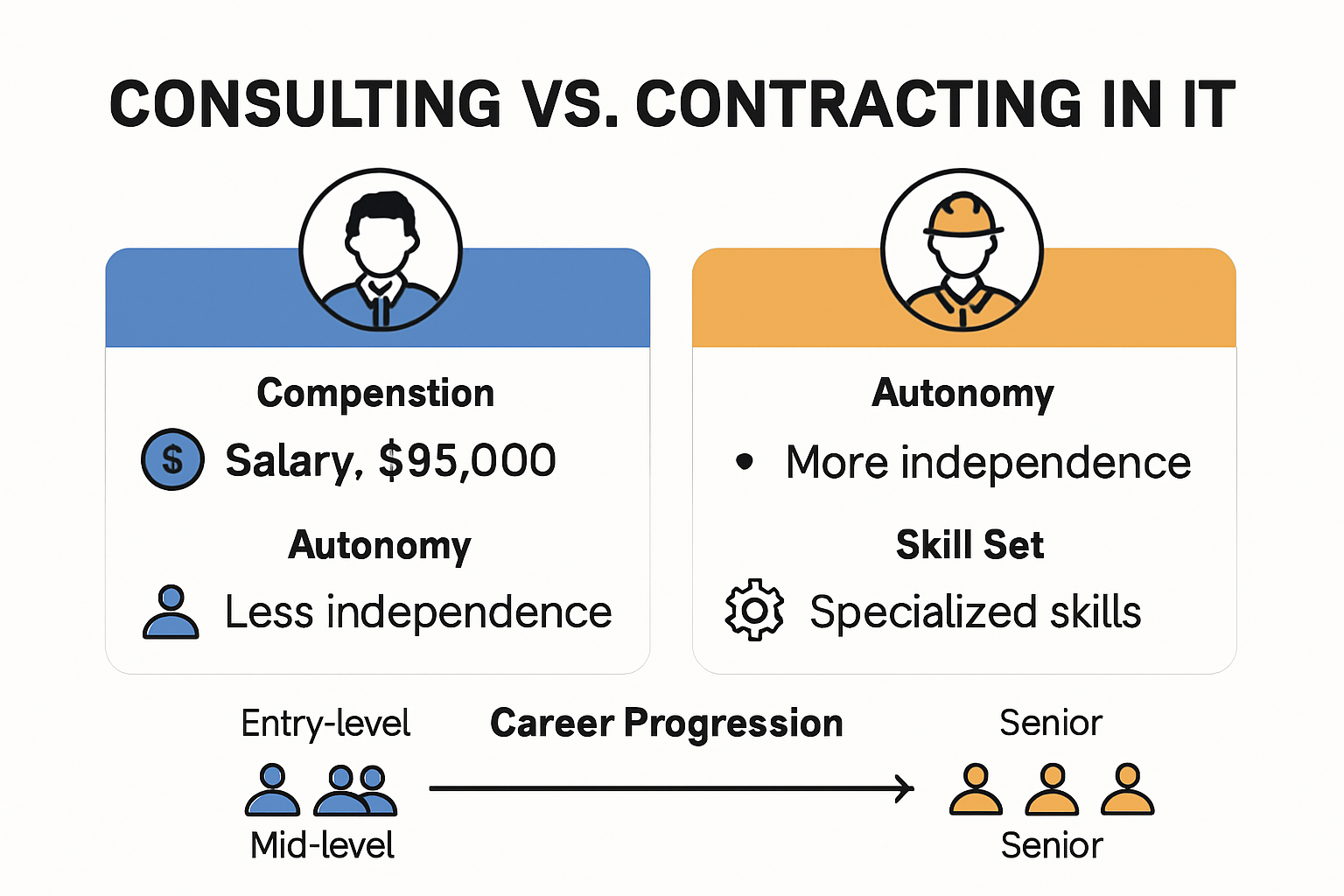
Compensation models for consultants and contractors exhibit significant variations. Consultants typically command higher hourly or project-based rates due to their strategic expertise and comprehensive problem-solving capabilities. Their compensation often reflects the value of strategic insights and transformative recommendations they provide to organizations.
Contractors, while generally earning competitive rates, tend to have more standardized compensation structures directly tied to specific technical skills and project deliverables. Their earning potential is more closely linked to the immediate technical tasks they perform, with rates varying based on specialized technical expertise and project complexity.
A study from the Federal Acquisition Institute suggests that continuous professional development and skill enhancement can significantly impact earning potential for both consultants and contractors. Professionals who invest in expanding their technical and strategic capabilities often see more substantial financial rewards.
Work Flexibility and Professional Autonomy
Research from arXiv indicates that the modern work environment, particularly in the wake of the COVID-19 pandemic, has dramatically transformed professional flexibility. Consultants typically enjoy greater autonomy, with the ability to choose projects, set their work schedules, and often work remotely. This flexibility allows them to manage multiple client engagements simultaneously and design work experiences that align with their professional goals.
Contractors, while also experiencing significant workplace flexibility, tend to have more structured engagement models. Their work is often more tightly integrated with specific project teams and organizational timelines. However, the rise of remote work has expanded opportunities for contractors to work from diverse locations and maintain more adaptable work arrangements.
Career Growth and Professional Development
Career trajectories for consultants and contractors differ substantially. Consultants often have opportunities to develop broad, strategic skill sets that can lead to roles in senior management, strategic advisory positions, or entrepreneurial ventures. Their work exposes them to diverse organizational challenges, enabling them to build comprehensive professional networks and gain insights across multiple industries.
Contractors typically develop deep, specialized technical expertise. Their career growth is more focused on becoming increasingly proficient in specific technological domains, potentially leading to roles as technical specialists, lead developers, or subject matter experts in niche technological areas.
Explore more about choosing the right professional path to align your career strategy with your long-term professional aspirations.
Ultimately, both consulting and contracting offer unique advantages. The optimal choice depends on individual career goals, personal working style, desired level of autonomy, and professional development objectives. Successful IT professionals carefully evaluate these factors to create a career strategy that maximizes their potential, satisfaction, and professional growth.
Legal and Tax Factors in Canada and USA
Navigating the complex legal and tax landscape is a critical consideration for IT professionals choosing between consulting and contracting. The regulatory environment in Canada and the United States presents unique challenges and opportunities that can significantly impact professional and financial strategies.
Classification and Compliance Considerations
The distinction between consultants and contractors extends beyond professional roles and into critical legal and tax domains. According to the University of Texas at Austin, proper classification is fundamental to ensuring compliance with federal regulations and avoiding potential legal complications.
Both countries have stringent guidelines for determining worker status. The IRS and Canada Revenue Agency employ specific criteria to differentiate between independent contractors and employees. Key factors include the degree of control over work performance, financial investment in the business, potential for profit or loss, and the permanence of the working relationship.
Misclassification can result in significant financial penalties. The University of Illinois highlights that incorrect worker classification can lead to substantial tax liabilities, retroactive employment taxes, and potential legal challenges.
Tax Implications and Reporting Requirements
Tax structures for consultants and contractors differ substantially. Consultants often operate as incorporated businesses or sole proprietorships, which provides unique tax advantages and reporting requirements. This structure allows for more sophisticated tax planning, including the ability to deduct business expenses, manage income splitting, and potentially optimize tax rates.
Contractors typically have more straightforward tax reporting but fewer strategic tax planning opportunities. They must carefully track income, maintain detailed records, and understand the nuanced tax implications of their professional status. Both groups must navigate complex reporting requirements, including managing GST/HST in Canada or sales tax equivalents in the United States.
Business Registration and Legal Protections
Professional registration is a critical step for both consultants and contractors. Learn more about establishing your professional business structure to ensure comprehensive legal protection and compliance.
The University System of Georgia’s guidelines emphasize the importance of understanding worker classification from both legal and tax perspectives. Consultants often benefit from more robust legal protections through formal business structures, including limited liability corporations or professional corporations that provide personal asset protection.
Contractors must be equally diligent in understanding their legal status. This includes creating clear contract agreements, maintaining professional liability insurance, and ensuring compliance with local and federal regulations governing independent work.
The following table summarizes key legal and tax considerations for IT consultants and contractors in Canada and the USA, as discussed in the article.
Consideration | Consultant | Contractor |
Worker Classification | Strategic, distinct from employee | Task-based, distinct from employee |
Business Structure | Often incorporated or sole proprietorship | Usually sole proprietorship or incorporated |
Tax Advantages | More tax planning (deductions, splitting) | Straightforward, fewer planning options |
Reporting Requirements | Complex reporting, multiple obligations | Must track income and report independently |
Legal Protections | Access to limited liability structures | May require own liability insurance |
Risk of Misclassification | Yes | Yes |
Compliance Consequences | Penalties for misclassification | Penalties for misclassification |
Navigating these legal and tax considerations requires careful planning and potentially professional guidance. IT professionals must consider not just the immediate financial implications but also long-term strategic advantages of their chosen professional path. The complexity of these factors underscores the importance of consulting with tax professionals, legal advisors, and industry experts who can provide tailored guidance specific to individual circumstances.
Ultimately, success in consulting or contracting depends on a comprehensive understanding of these legal and tax dynamics. Professionals who invest time in understanding these nuanced considerations position themselves for more sustainable and financially optimized careers.
Choosing the Right Path for Your IT Career
Selecting the optimal professional trajectory in IT requires careful self-assessment, strategic planning, and a deep understanding of personal career goals. The decision between consulting and contracting is not merely a professional choice but a significant life strategy that impacts personal growth, financial stability, and long-term career satisfaction.
Personal Skills and Professional Alignment
According to Tulane University’s School of Professional Advancement, the choice between consulting and contracting depends significantly on individual professional strengths and personal preferences. IT professionals must critically evaluate their skill sets, working style, and career aspirations.
Consulting is ideally suited for professionals who excel in strategic thinking, possess strong communication skills, and enjoy solving complex organizational challenges. These individuals thrive on variety, can quickly adapt to different organizational cultures, and have the ability to provide high-level strategic recommendations.
Contractors, by contrast, are typically most successful when they have deep technical expertise, enjoy hands-on implementation, and prefer more structured project environments. They excel at executing specific technical tasks with precision and are comfortable working within defined project parameters.
Career Development and Long-Term Prospects
Career trajectory considerations play a crucial role in this decision. The Federal Acquisition Institute’s professional roadmap emphasizes the importance of understanding personal professional development goals when choosing between consulting and contracting.
Consulting offers broader exposure to diverse industries and challenges, potentially leading to opportunities in strategic advisory roles, executive positions, or entrepreneurial ventures. Consultants often build comprehensive professional networks and develop a versatile skill set that can be applied across multiple domains.
Contractors typically develop deep, specialized technical expertise. Their career growth is more focused on becoming increasingly proficient in specific technological domains, potentially leading to roles as technical specialists, lead developers, or subject matter experts in niche technological areas.
Practical Considerations and Personal Readiness
Explore strategies for transitioning into your ideal professional path to ensure a smooth and successful career transformation.
Beyond technical skills, successful consulting and contracting require specific personal attributes. Consultants need exceptional interpersonal skills, the ability to build rapid trust with clients, and confidence in delivering strategic recommendations. Contractors must demonstrate technical precision, reliability, and the capacity to integrate quickly into project teams.
Financial preparedness is another critical factor. Consulting and contracting both offer unique financial opportunities but also come with distinct challenges. Consultants often have higher earning potential but must manage business development, marketing, and administrative tasks. Contractors typically have more predictable income streams but may face more limited growth opportunities.
The decision between consulting and contracting is not permanent. Many IT professionals transition between these modes throughout their careers, leveraging different approaches at various professional stages. The key is maintaining flexibility, continuously developing skills, and remaining adaptable to market demands.
Ultimately, the right path is deeply personal. Success comes from aligning professional choices with individual strengths, career goals, and personal values. IT professionals who take a thoughtful, strategic approach to their career development will find fulfillment and success, regardless of whether they choose consulting or contracting.
Frequently Asked Questions
What is the primary difference between consulting and contracting in IT?
Consulting focuses on providing strategic advice and high-level recommendations to solve business challenges, while contracting is centered around executing specific technical tasks and deliverables.
How do compensation structures differ for consultants and contractors?
Consultants typically earn higher rates due to their expertise and strategic role, whereas contractors have more standardized pay based on specific technical tasks and deliverables.
What are the career growth opportunities for consultants compared to contractors?
Consultants often have broader career growth paths leading to strategic roles or entrepreneurship, while contractors develop deep technical expertise, which can lead to specialized roles within their technical domain.
What legal and tax considerations should IT professionals know when choosing between consulting and contracting?
Both consultants and contractors must understand worker classification, tax implications, and registration requirements, as these can affect their legal status, tax obligations, and financial opportunities.
Ready to Master the Shift from Contracting to Consulting?
Are you weighing the leap from contracting to consulting and feeling unsure how to get started or secure higher rates? The article you just read explored how shifting to consulting can offer you more income, choice, and growth but also showed just how many legal, strategic, and tax challenges you face on the way. If you feel stuck between chasing better opportunities and avoiding costly mistakes, you are not alone. Many IT pros share the same worries about transitioning, building client relationships, and setting the right fees.

Let The Consultant’s Compass be your trusted partner on this journey. With over a decade of proven expertise, Carlos shares no-nonsense tools and guidance designed for Canadian and US professionals like you. The bestselling guide Becoming a Solo Consultant – The Consultant’s Compass is packed with rate calculators, contract templates, and a step-by-step roadmap to help you move forward with confidence. If you are ready to build freedom and control into your IT career and avoid the classic consulting pitfalls, visit The Consultant’s Compass and get started now.
Recommended


Comments